Complete Guide to Enterprise Workflow Automation in 2025

Business owners and entrepreneurs are frequently perplexed by how to streamline various procedures while also enabling team members to reach the same goal. They understand the value of enhanced collaboration and communication across divisions or groups. A critical challenge — division and individualism in different sections of a firm — drives the requirement for effective intercommunication solutions. Employees only concentrate on solving specific difficulties rather than having a holistic picture of their location in the workflow.

Therefore, a lack of cross-departmental collaboration might be fatal. Over 80% of business leaders say they are accelerating work process automation and broadening their use of remote work. Recognizing the benefits of management software for enterprise workflow automation allows your task-solving team members to visualize their work’s influence, value, and effect on other business areas and processes. According to Gartner, by 2024, 69 percent of all managerial roles will be automated.

Here’s where our A8Studio comes to life! The A8Studio environment allows you to design end-to-end automation across your customer experiences, from customer service to incorporating deep insights into your core business processes. With the rise of hyperautomation, businesses can take automation to the next level by combining artificial intelligence (AI), machine learning (ML), and robotic process automation (RPA) technologies.

What Is Enterprise Workflow Automation?

Workflow automation is an automated method of checking tasks, documents, and data flow over work-based protocols that follow the desired business rules. When correctly done, this form of automation ought to be a simple process carried out on a routine basis to boost daily productivity.

The term “workflow” is also widely used to describe the techniques, patterns, and activities that help group members organize and arrange their work, as well as the stages that allow them to complete the assignment. Workflow automation is organizing a task to complete it and, as a result, meet the objectives.

For individuals, a workflow is a series of processes that they must follow to achieve the desired results. A workflow is defined as a set of duties allocated to each member of a small or large group, which they must complete to gain group benefits or achieve common goals that benefit the team.

Hyperautomation is an extension of workflow automation that leverages advanced technologies such as AI, ML, and RPA to automate complex and end-to-end business processes. It goes beyond traditional workflow automation by incorporating intelligent decision-making capabilities and the ability to handle unstructured data. Hyperautomation enables businesses to automate repetitive tasks, optimize processes, and drive greater efficiency and productivity.

There are numerous examples of enterprise workflow automation, ranging from following a culinary recipe to organizing office chores. Companies that use enterprise workflow management strategies and enterprise workflow automation in sales, marketing, and HR profit greatly because this approach requires organization, dedication, and discipline to complete tasks.

73 percent of IT leaders report that employees are saving between 10 and 50 percent of the time they previously spent doing manual processes, a boon of the automation process.

You’ll need a few key components to create a productive and efficient workflow. First, you must understand each process stage’s necessary data and resources. Second, you must create an algorithm that people or software will take as the standard.

Finally, specify an outcome that justifies the work, time, and data spent on the process. Because of the significance of these process automation components, you should set them up cautiously and thoroughly, as incorrect calculations result in inaccurate outcomes.

Recent Statistics of Enterprise Workflow Automation Benefits

  • Over 85% of businesses have integrated workflow automation, with 60% planning to expand capabilities by 2025.
  • Organizations report cost savings of 30-50% within the first year of adoption.
  • 73% of IT leaders note time savings of 10-50% due to reduced manual processes.
  • Automating workflows reduces human errors by up to 91%.
  • Companies adopting full automation grow revenue 25% faster than manual competitors.

How Does Enterprise Workflow Automation Work?

Workflow automation usually uses many if/then statements for initiating action. It then splits out based on what action a lead, employee, or other stakeholder took.

Workflow automation, in a nutshell, is the use of software to organize and automate complicated business processes. Visual design tools are frequently used in competitive process automation services, allowing customers to “sketch” their workflows, somewhat like creating a flowchart.

Users can place nodes along this sketched workflow that automate various operations, such as data recording, to quickly link systems, data, and people across all parts of the enterprise. 

It becomes easier for people to work productively and devote their time to meaningful, worthwhile tasks rather than mundane (and frequently thoughtless) ones.

Industry-leading tools go even further, with AI-powered workflow management advice, simple integration with other enterprise workflow solutions, intelligent records management, and much more. Upon implementing workflow automation, enterprises begin to notice significant transformations taking place.

Top Workflow Automation Tools in 2025

Here are the leading platforms driving workflow automation this year:

Autonom8’s A8Studio – A low-code GenAI platform for designing end-to-end workflows across banking, healthcare, education, and customer service.

UiPath – Strong in robotic process automation (RPA).

UI Path

ServiceNow – Popular for enterprise IT workflows and scale.

Servicenow

Zapier for Enterprises – Expanded in 2025 with AI-powered connectors.

Microsoft Power Automate – Deeply embedded in Microsoft 365.

Microsoft Power Automate

Workato – Known for API-led enterprise integrations.

Workato

When choosing a tool, compare ease of use, integration capability, AI features, and cost of scaling.

The Future of Enterprise Workflow Automation in 2025

In 2025, enterprise workflow automation has moved beyond simple task automation. Today, businesses are adopting intelligent and adaptive workflows that predict, decide, and act in real time.

  • AI-First Workflows: Predictive analytics and machine learning help identify and resolve bottlenecks before they impact operations.

  • Generative Automation: Large Language Models (LLMs) now draft documents, route approvals, and even design workflows on the fly.

  • Cloud + Edge Integration: Combining cloud scalability with edge computing enables industries like healthcare, retail, and logistics to automate processes closer to where data is generated.

The global workflow automation market is projected to grow from $29.9B in 2022 to $87.7B by 2030, with AI-driven solutions leading the charge.

Importance of Workflow Automation

Modern firms grapple with the digitalisation dilemma of harmonising internal and external business interactions in a world where email, smartphones, databases, whiteboards, and post-it notes dominate project and work management.

These task-oriented business solutions rely heavily on human memory and are ineffective at facilitating collaboration and providing visibility when a worker or decision-maker needs help.

Organizations can use enterprise workflow management software to reduce reliance on these interactions and tracking technologies by guaranteeing that all work task data and interactions are either done within the platform or by tracking work assignments.

In essence, an enterprise workflow system is essential since it continuously provides an excellent experience for customers, both internally and externally, when it comes to the finished work output.

Work is completed more quickly, and individuals can accomplish more with their means. Additionally, your organization and division managers will be able to validate budget allocations and achievements based on facts rather than emotions.

In the end, workflow automation is important because it allows you to achieve a competitive edge over manually-driven competitors by providing improved work and services at a lesser cost while making quick and informed decisions.

Read also: What is Customer Journey Analytics? & Why is it Important?

Benefits of Workflow Automation

Let us look at some vital advantages of workflow automation.

  Decreased workflow cycles (With reduced cycle times, productivity can be boosted – a more productive workforce)

  Less demand for human labor (Cost savings from automation through the reduction of employee number)

  Less requirement for manual processing and handling (48 percent of organizations are implementing automation solutions to reduce manual tasks)

  More transparency; greater visibility enables faster identification of operational constraints

Benefits of Workflow Automation

  Enhanced customer satisfaction when the focus is on the client (Embed conversations with your customers and deploy solutions wherever they are)

  More employee satisfaction with advanced workflow analytics, such as KPIs

  More accountability for who is accountable for what in an organization.

  Enhanced output; cost savings; and reduced risk of human error (AI is currently being used by 25% of organizations in their process automation efforts, with the remaining 53% planning to implement it soon)

  Flexibility, as workflow automation can be altered and extended as needed

  Much more effective task management (52 percent of business leaders believe they can automate 10-30% of their daily tasks)

Workflows must be automated whenever feasible for various reasons, including quicker operations, timely delivery, seamless functioning as per the reasons stated above.

Related article: A Complete Overview of LCNC Platforms

Enterprise Workflow Automation Examples / Use Cases

Workflow automation may be implemented in almost every team and any business situation. While it is most commonly associated with marketing and sales, it can also be applied to operations, customer support, human resources, and financial management. 

Following are the ways on how workflow automation can be implemented across functions:

  • Marketing: More than 80% of marketing departments automate various marketing tasks, such as sharing business mails and updating the status on different social media handles. You can plan your overall calendar for social media to manage the workflows that cultivate specific clients with offer notifications using our marketing automation software.
  • Sales: Three-quarters of businesses report that automated landing pages can effectively generate leads. It can automate time-consuming management protocols, allowing sales reps to pay attention to product selling rather than data entry. Aside from moving leads over traditional methods, you can automate things based on their performance. An automated sales workflow can add potential leads in managing campaigns and updating various deal implementations.
  • Finance: Financial institutions such as wealth management, investment services, mortgage, and brokerage firms have complex workflows and stringent requirements for file security. Finance process automation software can help you streamline all such processes, reimbursements, and budget approvals by allowing you to create forms, design workflows, and track processes.
  • IT: Workflow automation helps organize network users across several departments, such as sales, finance, administrative, and operational teams, for in-house core networks. AI is used by 62 percent of organizations to support IT operations, 54 percent to enhance business process efficiency, 48 percent to support manufacturing operations, and 49 percent for research and innovation.
  • Human Resources: Manually entering all of your new hires’ personal information, such as employee data, location, personal details, and much more, can be tedious. However, HR automation software can do it all in a few minutes. 70% of business leaders believe that an automation tool could help them build more effective teams. 

Case Studies: Real-World Automation in 2025

  • Retail: A global footwear company uses AI agents to automate customer service emails, reducing resolution time from days to seconds.

  • Healthcare: Hospitals automate patient onboarding and compliance workflows using low-code platforms.

  • Banking: Conversational AI speeds up loan approvals and compliance checks, cutting turnaround time by 60%.

How to Build an Automated Workflow?

Automated workflows can be designed and constructed visually using a drag-and-drop interface to add and organize jobs, simulating or improving current processes. In most cases, the process is depicted statically and checked for accuracy by all stakeholders.

After the static design is complete, development on the actual process includes forms, tasks, recipients, alerts/notifications, and much more. It can be accomplished using enterprise workflow software, which provides pre-built activities that may be rearranged and connected as needed.

Implementing an automated workflow typically involves five steps. The first stage involves checking for repetitive tasks and determining whether they could be automated. If an organization notices that a part of its workflow may be improved, it should explore automating that process; this step necessitates a thorough understanding of business operations.

The next stage is to establish business objectives. To accomplish it, a company must answer how workflow automation will help them reach their business goals in whatever area they choose.

The third stage should be to determine which workflow automation software is required. This step requires the company to decide which automation software should meet its newly laid out business objectives.

Employees must be trained to use the new workflow automation software in the fourth phase. The final stage is tracking KPIs and making changes to the workflow. It should be completed after the new workflow is ready. Continuous monitoring and measuring can help improve enterprise workflow.

Dynamic vs. Static Workflows

Dynamic and static enterprise workflow automation is also possible. When an automated process is dynamic, programs can use a model template to determine what step to execute next at the time of execution.

There is no variation in an automated procedure when it is static. If external variables could alter the outcome, steps must be followed in a specific order. For enhancing agility, a dynamic workflow should cooperate with automation whenever possible.

Workflow Automation vs. RPA

Robotic process automation (RPA) is conceptually similar to workflow automation. But what exactly is the difference between RPA and Workflow Automation?

Workflow Automation focuses on automating flow between work activities across a process, whereas RPA focuses on automating individual work activities. RPA is a great fit for work tasks heavily focused on rules and procedures. 

However, RPA can be paired with cognitive technology that moves deeper and more successfully into expertise and judgment-based labor functions. Both workflow automation and RPA use software to automate tasks, but workflow automation emphasizes interaction between workflow elements. 

Workflow automation software, for example, could be used in the supply chain to ensure that the right person is alerted about what work needs to be done next at the correct time.

Emerging Trends in Workflow Automation (2025 Edition)

  • Self-Optimizing Workflows: Systems automatically adjust based on performance data.

  • AI Agents in Operations: Conversational AI agents interact with employees and customers to resolve issues dynamically.

  • Sustainability Goals: Automation is being applied to reduce waste and optimize energy usage.

  • Generative SEO & AEO (Answer Engine Optimization): Enterprises are optimizing workflows so AI search engines like ChatGPT, Perplexity, and Bard can discover and summarize them.

How to Find the Right Workflow Automation Software for Your Business?

Workflow automation is essential for companies that want to scale and grow without allowing anything to slip through the cracks. Twenty-four percent of organizations have already implemented low-code workflow automation software like A8Studio. Thus, you can successfully grow your business without experiencing any rough patches by allowing technology to complete manual tasks.

Workflow automation software packages present basic as well as complex automation solutions. Hence, while choosing the right enterprise workflow software, enterprises must possess a clear and profound understanding of their requirements.

The major factors that businesses must consider before choosing a solution include: 

  • Integration capabilities
  • Cloud-based delivery
  • Flexibility
  • Customized workflows
  • Usability

Shortly, 29 percent of organizations intend to implement low-code workflow automation software. Therefore, a good automation solution can easily integrate into existing software, be user-friendly and flexible, and most importantly, a cloud-based application.

Automation Strategy

Organizations implementing automation solutions

Workflow Automation Software Trial – Autonom8

Workforce automation software solutions are effective when you test the software for your needs. A8 offers free trials that you can use to evaluate the flow package for your business and decide its efficacy.

A8 works on low-code and presents enterprise-grade automation solutions to build customer-centric workflows. Additionally, A8 offers instant implementation with end-to-end workflow automation.

The robust A8 automation platform is flexible and leverages low code to build intelligent customer workflows. Learn more about how Autonom8 can enable your business to use scalable features across business workflows.

Enterprise Workflow Automation Market Outlook 2025

  • 87% of enterprises say workflow automation is a top investment priority in 2025 (Gartner)

  • Companies adopting hyperautomation report 30–50% cost savings in the first year.

  • AI-driven automation improves productivity by 40%, cutting errors and freeing employees for higher-value work.

FAQs on Enterprise Workflow Automation

What is an enterprise workflow?

An enterprise workflow defines the hundreds of processes that keep large organizations running. It refers to the standard processes that an enterprise needs to follow.

What is workflow and process automation?

Workflow is the sequence of activities required to complete a task. Process automation refers to the automation and streamlining of complex business processes using technology.

How do you automate workflows?

Workflow automation is the design, implementation, and automation of workflow-based processes. Human tasks, data, or documents are routed between people or devices, based on predefined standard operating procedures.

Is RPA workflow automation?

RPA is a type of automation that works on the front end of your system. RPA is used to collaborate with humans by automating time-consuming processes.

What is a workflow automation tool?

Workflow automation tools, a human-centric way of managing and automating overall business processes, are the business user's solution to business process management software.

A Complete Overview of Intelligent Automation

Imagine a world where businesses can perform complex tasks like decision-making, data analysis, and customer service without human intervention. This is the future of intelligent automation, and it’s already becoming a reality. By 2025, intelligent automation will be deeply integrated into businesses, transforming industries and providing a significant competitive edge. Whether it’s automating routine tasks or making data-driven decisions, intelligent automation will help organizations streamline operations, reduce costs, and enhance productivity.

In today’s fast-paced world, organizations need to remain agile and efficient. Intelligent automation offers the key to achieving this by using technologies like AI, machine learning (ML), and robotic process automation (RPA) to handle tasks that were once exclusively managed by humans. The future of business will be driven by these technologies, allowing businesses to scale, innovate, and deliver better customer experiences.

First things first, however – what does Intelligent Automation entail anyway? 

Introduction to Intelligent Automation

For the uninitiated, Intelligent Automation refers to using technology, such as artificial intelligence and machine learning, to perform tasks that usually require human intervention. It can automate a wide range of processes, from simple tasks like data entry to complex processes like decision-making. Intelligent automation has the potential to improve efficiency and productivity significantly, as well as reduce the need for human labor in specific industries.

Imagine you’re a customer service representative overwhelmed by thousands of customer inquiries. Instead of spending hours answering repetitive questions, an AI-powered chatbot steps in to handle the workload, providing instant responses to customers. This is a simple example of intelligent automation at work.

Intelligent automation is designed to handle both simple and complex tasks by combining AI, machine learning, RPA, and other technologies. It allows businesses to automate repetitive tasks like data entry and even complex decision-making processes, such as loan approvals based on credit scores. Intelligent automation systems analyze data, learn from it, and use this knowledge to improve their performance over time, making them more efficient and accurate.

Key components of intelligent automation include:

  • Rule-based automation: Using predefined rules to automate repetitive tasks like data processing.
  • Machine learning-based automation: Automating tasks that require pattern recognition or decision-making based on historical data.
  • Cognitive automation: Using AI and ML to make decisions and solve problems, such as troubleshooting technical issues or personalizing customer interactions.

By incorporating these technologies, businesses can automate complex workflows, reduce human error, and improve operational efficiency.

Related article: Top 10 Intelligent Automation Trends and Predictions in 2023

The Importance of Intelligent Automation in 2025

Picture a scenario where a global retailer is trying to manage its supply chain during a time of uncertainty. Traditional methods of tracking inventory and managing shipments would take weeks to adjust. However, with intelligent automation, the retailer can use AI-powered systems to analyze data in real-time, predict shortages, and automatically reorder stock—keeping shelves full and customers happy.

Intelligent automation is no longer a luxury but a necessity in today’s fast-paced, technology-driven environment. It helps organizations remain competitive by:

  • Reducing operational costs: By automating repetitive tasks, businesses can significantly reduce the time and labor needed to complete them.
  • Improving accuracy: With AI and machine learning, businesses can automate tasks that require a high degree of precision, such as financial analysis or regulatory compliance.
  • Enhancing customer experience: Automated systems can quickly respond to customer inquiries, improving response times and satisfaction.

As organizations continue to embrace digital transformation, intelligent automation will become a critical tool for staying ahead of competitors and meeting customer expectations.

The Future of Intelligent Automation in 2025

In 2025, intelligent automation is shifting from process automation to decision automation. Enterprises no longer just automate repetitive tasks—they now trust automation platforms to make recommendations, resolve exceptions, and even take autonomous action.

Key advances this year include:

  • Generative AI + Automation: LLMs can now analyze documents, draft contracts, and update systems without manual input.

  • AI Agents for Business Ops: Intelligent agents interact with employees, customers, and partners across channels, driving workflows end-to-end.

  • Industry-Specific IA: In banking, IA manages compliance and onboarding; in healthcare, it automates patient intake and diagnosis support; in retail, it handles supply chain forecasting.

  • Governance & Trust: More organizations are adopting Responsible AI frameworks to ensure compliance, data privacy, and explainable automation.

According to Deloitte, enterprises using intelligent automation at scale report 3x faster decision-making and 50% lower error rates compared to manual operations.

How does Intelligent Automation work?

Intelligence Automation is designed to improve efficiency and accuracy by automating repetitive, predictable tasks and making decisions based on data. 

Listed below are a few of the several ways in which it can be implemented:

Rule-based automation

This automation involves using predefined rules to make decisions and perform tasks. For example, a rule-based system might automatically approve or reject loan applications based on credit score, income, and other factors.

Machine learning-based automation

This type of automation involves using algorithms that can learn from data and improve their performance over time. Machine learning-based systems can be used to automate tasks that require pattern recognition or even decision-making based on input data.

Knowledge-based automation

This automation involves using a knowledge base, a collection of information and rules, to make decisions and perform tasks. A knowledge-based system, when applied, might be used to diagnose and troubleshoot technical issues.

Intelligent Automation systems can be trained using a variety of methods, including supervised learning, where the system is provided with labeled examples and learns to make predictions based on them, and unsupervised learning, where the system is provided with a large amount of data and must find patterns and relationships within it. It also extensively involves using technology to automate tasks that humans usually do. There are several ways that this can be accomplished:

  • Robotic process automation (RPA): RPA involves using software robots or “bots” to automate tasks. These bots are programmed to mimic human actions, such as typing and clicking, to complete tasks on a computer.
  • Cognitive automation involves using artificial intelligence (AI) and machine learning to automate tasks. This automation can analyse data and make decisions based on that data, enabling it to perform more complex tasks than RPA.
  • Natural language processing (NLP): NLP is a type of AI that allows computers to understand, interpret, and generate human language. This can automate tasks such as customer service inquiries or document reviews.

Companies globally have noted this efficiency, and reports from Deloitte state that over 85 percent of organizations are rethinking how work is done and have or will soon begin using intelligent automation. 

Related article: A Complete Guide to No-code Development for 2023

Benefits of Intelligent Automation 

The number of benefits to organizations. include increased efficiency, accuracy, and speed. Some specific advantages of intelligent automation include the following: 

Benefits of Intelligent Automation

On this note, studies conducted by Accenture indicate that even a standard automation solution, such as a successful RPA implementation, has the ability to generate a 40 to 80 percent reduction in processing costs and an 80 percent reduction in processing time. 

Imagine a financial services firm struggling with the high costs of processing loan applications. By implementing intelligent automation, the company can reduce processing time by 80%, lowering costs while improving accuracy. This is just one of the many benefits of intelligent automation.

Here are some key benefits businesses can expect from implementing intelligent automation:

  • Increased efficiency: Automating tasks like data entry, document processing, and decision-making can free up employees to focus on more strategic tasks.
  • Cost reduction: As mentioned, businesses can reduce processing costs by up to 80% by automating manual tasks.
  • Faster decision-making: AI and machine learning enable businesses to make data-driven decisions in real-time, improving speed and agility.
  • Enhanced scalability: Intelligent automation enables businesses to scale operations without having to hire additional employees, handling increased demand without added costs.

These benefits contribute to a more efficient, cost-effective, and innovative business model that can adapt quickly to changing market conditions.

Emerging Trends in Intelligent Automation (2025 Edition)

  • Autonomous Workflows: IA platforms can now self-monitor and self-correct without human intervention.

  • Generative Decision Support: AI generates multiple “what-if” scenarios for leaders before decisions are made.

  • Intelligent Document Processing 2.0: NLP models extract context from contracts, invoices, and reports at human-level accuracy.

  • Hybrid Human + AI Teams: Employees collaborate with automation agents, shifting from task execution to oversight and strategy.

  • AI-Powered Compliance Automation: Automatically audits processes, flags anomalies, and ensures real-time regulatory adherence.

Related article: What is Low-Code Automation? Everything You Need to Know

RPA and Intelligent Automation: What are the differences?

Robotic process automation (RPA) is a technology that allows organizations to automate repetitive, predictable tasks by using bots to mimic human actions, such as typing and clicking. RPA is typically used to automate tasks performed on a computer, such as data entry or document processing.

Intelligent automation, on the other hand, refers to the use of technology, including AI and ML, to automate tasks. This can include RPA, as well as other types of automation, such as cognitive automation, as mentioned above, which involves the use of AI and machine learning to automate tasks, and NLP.

To summarise, RPA is a specific type of automation involving software robots to automate tasks. In contrast, intelligent automation is a broader term for using technology, including RPA, to automate tasks.

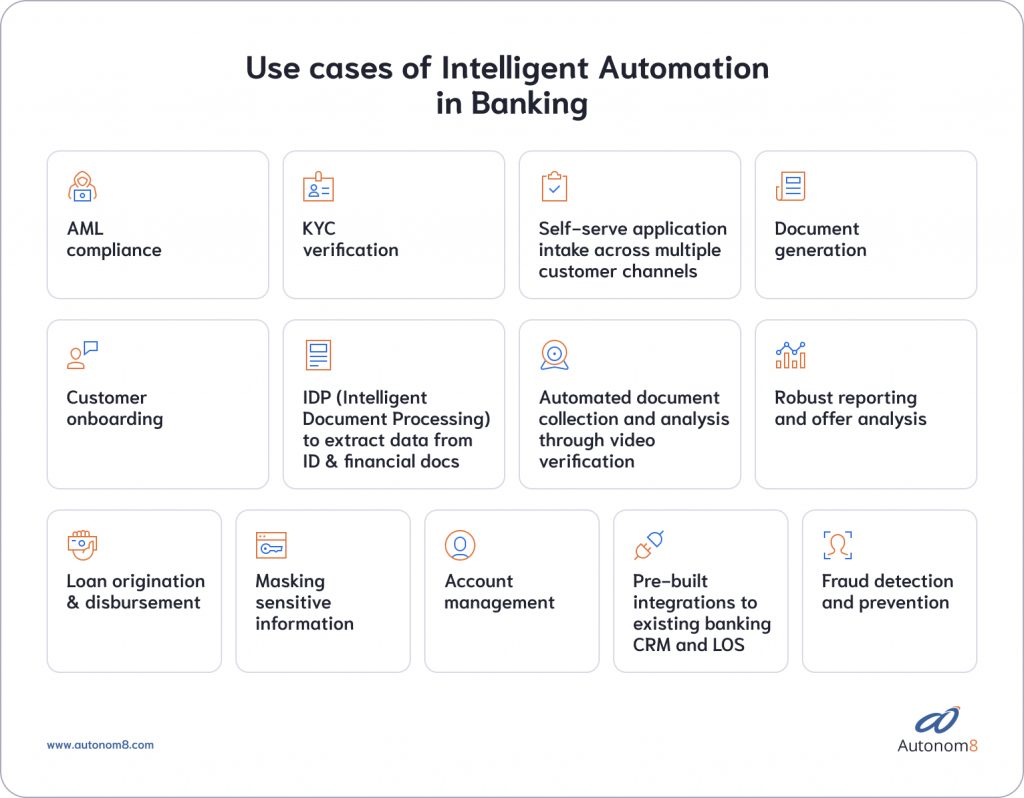
Related article: A complete overview of Intelligent Automation role in Banking

Intelligent Automation Examples / Use Cases

Here are a few examples of how intelligent automation is being used

  • Data entry: Intelligent automation can automate the process of entering data into computer systems, improving the speed and accuracy of data entry.
  • Customer service: AI-powered chatbots can handle customer inquiries, freeing up human customer service representatives to focus on more complex tasks.
  • Supply chain management: Intelligent automation can optimize the movement of goods through a supply chain, improving efficiency and reducing costs.
  • Healthcare: AI can be used to analyze medical images and assist with diagnosis, freeing up doctors to focus on more complex tasks.
  • Finance: Intelligent automation can process and analyze financial data, enabling organizations to make more informed decisions.

These are just a few examples of how intelligent automation is being used. As technology continues to advance, it is likely that we will see even more use cases for intelligent automation in the future. 

This is why intelligent automation can be found at the top of every organization’s strategic and tactical agendas. In fact, Gartner expects that by 2024, organizations will lower operational costs by 30% by combining hyper-automation technologies with redesigned operational processes. Overall, the future of intelligent automation is expected to be characterized by the increasing integration of AI and ML technologies into various aspects of modern life and the continued development of new and more advanced applications of these technologies.

Case Studies: Intelligent Automation in Action (2025)

  • Banking: A European bank uses Autonom8 IA to automate KYC checks and loan processing, reducing compliance costs by 40%.

  • Healthcare: US hospitals deploy IA-powered patient onboarding systems, cutting wait times from hours to minutes.

  • Retail: Global fashion retailers use IA for supply chain forecasting, leading to 20% fewer stockouts.

  • Insurance: Claims processing bots powered by AI cut approval times from weeks to 24 hours.

How to choose the right Intelligent Automation platform for your business?

There are a few key factors to consider when choosing the right intelligent automation platform for your business.

  1. Compatibility: Ensure the platform is compatible with your existing systems and processes.
  2. Integration: Consider how well the platform integrates with your other tools and technologies.
  3. Scalability: Choose a platform that can scale your business as it grows.
  4. Functionality: Look for a platform with the features and capabilities you need to automate your business processes.
  5. Support: Ensure the platform has good customer support and a strong track record of reliability.
  6. Cost: Compare the costs of different platforms and choose one that fits within your budget.
  7. Ease of use: Consider the learning curve and complexity of the platform, and choose one that is easy for your team to use.

It may also be helpful to research and read reviews or case studies from other businesses that have used the platform you are considering. This can help you better understand the platform’s strengths and weaknesses and how it has worked for others in similar situations.

Top Intelligent Automation Platforms in 2025

Some of the most widely adopted platforms in 2025 include:

  • Autonom8 – GenAI-driven, low-code IA platform with hyperautomation and conversational AI.

  • UiPath AI Center – Combines RPA with machine learning and AI models.

  • Automation Anywhere – Focused on scalable IA with strong governance features.

  • Blue Prism (SS&C) – Advanced automation for regulated industries like BFSI and healthcare.

  • Microsoft Power Automate + Copilot – Deep integration with Office 365 and Azure OpenAI.

  • ServiceNow IA – Workflow-driven IA for ITSM, HR, and enterprise operations.

When comparing platforms, focus on AI integration, scalability, and compliance-readiness, not just RPA features.

Intelligent Automation Platform Trial – Autonom8

When you’re looking for the right Intelligent Automation platform for your business needs, consider using Autonom8.

The Intelligent Automation trial we offer allows our users to experience firsthand how the platform can effectively streamline business processes and increase efficiency by automating repetitive and time-consuming tasks and workflows.  As a bonus, the intelligent Automation platform has been widely popular among its users owing to its ability to integrate with existing systems and its convenient, user-friendly interface.

Our users tell us that utilizing Autonom8’s Intelligent Automation platform is an exceedingly positive experience. Their testimonials state that many enterprises may benefit from integrating this technology into their operations to significantly improve efficiency and cost savings for organizations across various industries.

Start your trial today!

Market Outlook for Intelligent Automation in 2025

  • The global intelligent automation market is expected to exceed $60 billion by 2026, driven by GenAI adoption.

  • 72% of executives say IA is now a board-level priority (PwC 2025).

  • Companies deploying IA at scale report up to 200% ROI within 2 years, due to productivity gains and faster innovation cycles.

  • Cross-industry adoption is accelerating: BFSI, healthcare, retail, and manufacturing are leading adopters.

FAQs on Intelligent Automation

What is Intelligent Automation?

Intelligent automation (IA) refers to integrating robotics with multiple components from different emerging technologies.

What is an example of Intelligent Automation?

A popular example of Intelligent Automation in action sees intelligent bots extracting data from customer service interactions, emails, or reports. This extracted information automatically updates CRM data, such as customer information, purchases, and relevant logistics data.

What is the difference between RPA and intelligent automation?

RPA is a specific type of automation that involves the use of software robots to automate tasks, while intelligent automation is a broader term that refers to the use of technology, including RPA, to automate tasks.

What is the future of intelligent automation?

The future of intelligent automation will likely involve the continued development and deployment of AI and ML technologies in various industries and applications. These technologies are expected to play a key role in the digital transformation of businesses, governments, and other organisations, as they enable organisations to automate tasks, improve efficiency, and make more informed decisions.

What is the scope for intelligent automation?

The scope for intelligent automation is immensely vast, as these technologies can be applied to a wide range of industries and applications. Having seen use cases in the healthcare, finance, and customer support and service verticals, the scope for intelligent automation is limited only by the imagination.

The Definitive Guide to Conversational Banking

Introduction To Conversational Banking

Covid and evolving markets have empowered customers to make demands from businesses and this extends to banks as well. Services like Netflix, Amazon, and Spotify have transformed the meaning of the word ”customer experience”. And then there is Amazon Echo/Dot with Alexa, Google Home with Google Assistant, and Apple with Siri. All these virtual assistants have raised the bar across all industries, and businesses today are striving to meet the growing demands.

According to a Forrester report, 87%of businesses are aware that the typical banking experience is insufficient to keep customers happy nowadays. The quest for a better experience in the digital age has led to the development of conversational tools playing a major role across industries. Before we go any further, let us first understand what is the future of banking and the role played by Conversational Banking.

Conversational banking is better interaction with customers through various means of communication. It is not just limited to text and voice chat. The main objective for any business, including banks, is to get a deeper understanding of what their customers want and match their expectations. Conversational banking aims to forge relationships with customers by fostering trust through dialogue and streamlining the purchasing process.

Conversational banking is

  • Personalized
  • Streamlined & Seamless
  • Real-time
  • Relevant
  • Consistent

The goal of conversational banking is to forge relationships with customers by fostering trust through deep dialogue and streamlining the purchasing process.

Related article: The Role of Generative AI in Loan Origination System

Hyperautomation in Conversational Banking

One of the emerging trends in conversational banking is the integration of hyperautomation. Hyperautomation refers to the use of advanced technologies, such as artificial intelligence (AI), machine learning (ML), robotic process automation (RPA), and natural language processing (NLP), to automate and streamline business processes.

Hyperautomation plays a crucial role in enhancing the capabilities of conversational banking by enabling more efficient and personalized customer interactions. Here’s how hyperautomation can be applied in conversational banking:

1. Intelligent Chatbots:

Hyperautomation enables the development of intelligent chatbots that can understand and respond to customer queries in a more sophisticated manner. These chatbots can leverage AI and NLP technologies to interpret customer intent, provide accurate information, and offer personalized recommendations.

2. Advanced Analytics:

Hyperautomation facilitates the collection and analysis of large amounts of customer data in real-time. By applying ML algorithms to this data, banks can gain valuable insights into customer behavior, preferences, and needs. These insights can be used to deliver more targeted and personalized conversational banking experiences.

3. Process Automation:

Hyperautomation can automate repetitive and manual tasks within banking processes, such as account opening, loan applications, and account maintenance. By integrating RPA into conversational banking systems, banks can streamline these processes, reduce errors, and improve operational efficiency.

4. Seamless Integration:

Hyperautomation allows for seamless integration of conversational banking across various channels and touchpoints. Banks can leverage technologies like APIs and microservices to connect chatbots, voice assistants, and other conversational tools with existing banking systems, providing customers with a consistent and seamless experience.

5. Enhanced Security:

With the rise of digital interactions in conversational banking, ensuring the security of customer data is of paramount importance. Hyperautomation can help banks implement robust security measures, such as biometric authentication, encryption, and fraud detection algorithms, to protect customer information and transactions.

By incorporating hyperautomation into conversational banking, banks can not only meet the growing demands of customers but also achieve operational excellence and competitive advantage. The automation of processes, advanced analytics, and seamless integration capabilities provided by hyperautomation enable banks to deliver personalized, real-time, and efficient conversational banking experiences to their customers.

How Does Conversational Banking Work?

According to research by Digital Banking Report, 75% of financial institutions thought about leveraging conversation AI, data, and analytics to choose the best course of action. Therefore, banks must employ technology as efficiently as possible by utilizing Machine Learning (ML) and Artificial Intelligence (AI) to enhance the client experience.

How does conversational banking works

Digital banking utilizing voice, text messaging services, or visual engagement technologies is referred to as conversational banking. It implies that you can use messaging apps to communicate with the bank directly. Additionally, conversational banking allows financial institutions access to vital information about the intentions, ambitions, and financial behavior of their clients, allowing them to cross-sell products and services and provide pertinent guidance.

Conversational Banking can be initiated in real-time using conversational tools such as Artificial Intelligence [AI] chatbots, Virtual assistants, and voice assistants.

Related article: Conversational AI in banking in an era of social distancing

Benefits Of Conversational Banking

Customers today expect solutions within a few minutes, they are no longer willing to wait. From the very screen you are reading this post, you can open another tab and check your bank balance, credit score, shop for your home and even pay your bills.

Conversational tools therefore enable real-time updates, omnichannel presence & interaction, better lead generation and conversations that capture customer data through websites or social media channels. Subsequently, this improves operational efficiency and optimizes business cost through better utilization of resources and faster turnaround time for queries raised by customers, resolved instantly by banking chatbots.

Benefits for Customers

~ 24×7 availability – Customers don’t have to wait for a response to their query because of our 24-hour availability. The usual financial questions that customers ask can be handled by chatbots for banking that are available round-the-clock.

~ High-quality service — The error is identified faster and a viable solution is offered with the aid of digital engagement tools. The number of touchpoints is lowered, and first contact resolution is enhanced.

~ Proactive customer interaction – When clients need a solution right away, proactive outreach enables them to find it. This boosts brand loyalty and client happiness.

Benefits for Banks

~ Cost optimization – Chatbots can efficiently handle frequent client inquiries, which lowers operational expenses. Businesses spend close to $1.3 trillion fulfilling these requests, and using bots can help you cut costs by up to 30%.

~ Fewer Errors – Errors that occur during manual work run the danger of becoming major issues in the future. Conversational banking provides flawless service and prevents issues. AI chatbots, for instance, are programmed with all the information, thus errors are impossible.

~ Scalability – Chatbots are simple to scale up or down during busy banking hours or unexpected increases in consumer demand. They can handle large volumes of queries/chats without having an impact on the costs of the company.This is the highlight of integrating chatbots in the banking sector.

~ Resource allocation – With the help of conversational banking tools, automation of repetitive tasks is taken care of and therefore resources are freed up for other important tasks.

~ Better lead management – Chatbots are a good way to capture leads. A chatbot has access to numerous client touchpoints along the omnichannel purchasing journey, unlike a human salesman. Additionally, chatbots are equipped with a database of client insights that may be processed very quickly. They are thus ideally adapted to the job of sifting through the sales funnel a huge number of potential clients.

Related article: 11 Important Banking Processes to Automate with Workflow Management Software in 2022

Importance Of Conversational Banking

Analytics Insight has predicted that the Global Artificial Intelligence market revenue in the banking sector will touch a whopping USD 48.3 billion by 2025. Conversational banking addresses one of the biggest challenges that banks continue to face:

  • Difficulty in retaining & engaging with customers
  • High cost of Customer acquisition
  • Meeting the growing expectations of customers
  • Technology involved to boost connectivity and convenience is constantly evolving
  • Stiff Competition [from fintech, insurtech and neobanks]
  • Regulatory compliance is complex & time-consuming.

Related article: Increase Banking CSAT with Conversational AI Chatbots in 2023

Conversational Banking Use Cases

Here are just a few Conversational Banking based use cases where they can improve client experiences by utilizing conversational banking.

Transform interactions into transactions

Automate inquiries concerning transfer restrictions, recurring charges, bonus points, and expenses. Transform straightforward transactions into practical, pleasurable encounters. Customers are more inclined to suggest a bank to relatives and friends if they consistently like using it.

Auto-send notifications & reminders

Reminding customers of payment due dates and financial procedures will ease their minds. Inform clients of modifications to their credit ratings or pertinent news.

Automating FAQs

Help consumers discover ATMs, check interest rates, check bank balances, and much more. Provide consumers with the information they require, at the precise time they require it, by responding to questions concerning credit or loan applications. Banks that use Hubtype typically automate 80% of their total queries.

Track and meet SLAs (service level agreements)

Utilize intelligent automation to surpass performance thresholds. Cut first response times (FRTs) and, if necessary, escalate discussions to human agents.

In-App Live Chat

A seamless and simple customer experience is made possible by the opportunity to message a customer service staff directly. Real-time messaging between customers and agents is possible. In contrast to interacting with a chatbot, this adds a personal touch to the conversation and usually makes the customer feel better understood. Because it fosters a client-centric environment that supports the bank’s ultimate goal of retention, live customer service benefits the bank. Live, in-app chat is typically used to explore more complex banking issues or to ask questions about upgrading accounts.

Examples of Conversational Banking

Self learning AI chatbots across several larger banking institutions have proved to be especially helpful. When a consumer interacts with this proactive virtual assistant, it first ascertains their individual issue and either offers a solution or refers them to the proper support personnel. Additionally, it can offer interactions in many languages, geographical directions, and other location-based services.

Conversational IVR prioritizes urgent situations and immediately handles customer complaints. Customers typically had to wait over 2.4 minutes on the phone before speaking to a live customer service representative. Customers can only begin to articulate their problems after waiting for such a long time. Customers can use MindTitan’s Conversational IVR to ask questions in their own language and receive answers automatically without the help of a human agent by using only the most cutting-edge speech recognition software and machine learning technology.

Key Considerations When Choosing Conversational Banking

The future trend is clear: in order to compete with fintech, the legacy banking sector must incorporate Conversational Banking solutions to give customers a better experience. Costs are decreased, customer satisfaction and loyalty are dramatically increased, and human errors brought on by emotional states of mind are eliminated when using AI-powered Conversational IVR and chatbots. Making the process work could be difficult, so picking the proper technology partner is essential.

Questions to ask yourself before choosing a conversational banking tool/solution are:

  • What is your business objective for the next 5years?
  • How effective are your digital strategies?
  • Can a new AI/ML capability be integrated into your existing system?
  • Are your processes streamlined ?
  • How important is customer experience to your business?

Once you get answers to these questions, make a list of available conversational banking solutions providers and look for one that matches your requirements. Banks and others in the Financial services space can develop a flexible and personalized service that boosts the chances of forging successful relationships with consumers by utilizing those digital technologies that prioritize interaction.

How To Develop A Conversational Banking Experience In Your Bank?

Map your customer journey

Creating a map of your ideal customer’s journey and identifying the most frequent queries/challenges that are likely to come up at each phase is the first step in building your conversational banking experience. From this exercise, it becomes clear where the client needs help and where chatbots can help speed up processes and reduce fraud and errors as well.

Related article: What is Customer Journey Analytics? & Why is it Important?

Chalk out areas that require human intervention

Pay attention to your message, mobile, and various social media channels. Move through your customer experience as if you were a brand-new visitor to identify areas where human intervention will help tide over the challenges.

Customer data security

When designing a conversational banking experience, security and data protection should be front of mind because banking is a highly regulated sector. Meeting compliance standards is important due to the sensitive nature of the information communicated in these environments, which makes them a target for security attacks. Gaining and keeping customers’ trust is the whole idea of a conversational banking experience; data breaches can undo all trust-building efforts that came before them.

Measure Success Across Channels

Designing a conversational banking experience is complete only when you have a performance assessment metric in place. Prior to execution, setting goals for your new banking strategy is crucial. Then, when a sizable amount of time has passed, you can compare the client data gathered with the reference metrics. Through internal surveys, one can do the same for comments and experiences from employees.

Here are some potential trends and developments that could shape conversational banking in 2025

Improved NLP and AI

As NLP and AI technologies continue to advance, conversational banking will likely become more sophisticated and accurate. This could lead to a better understanding of customer requests, more personalized responses, and the ability to handle more complex queries.

Integration with more channels

In 2023, we can expect to see conversational banking being integrated with more channels beyond messaging apps and chatbots. Voice assistants, social media platforms, and even augmented reality (AR), and virtual reality (VR) interfaces could be incorporated to provide a seamless and personalized banking experience.

Enhanced security features

As the use of conversational banking becomes more widespread, there may be a greater emphasis on ensuring the security of customer data and transactions. This could include the use of biometric authentication, encryption, and secure data transfer protocols.

More personalized customer experiences

Conversational banking can provide a more personalized experience to customers by offering customized product recommendations, personalized financial advice, and tailored marketing messages. In 2023, we can expect to see more banks offering personalized services through conversational interfaces.

Increased automation

With the help of conversational banking, banks can automate many customer interactions, such as account balance inquiries, payment requests, and loan applications. In 2023, we can expect to see even more banking functions being automated through conversational interfaces, which can help to reduce costs and improve efficiency.

Overall, conversational banking is a rapidly evolving field, and we expect continued growth and innovation in the years ahead. As technology improves, conversational banking has the potential to transform the way we interact with banks and manage our finances.

Conversational Banking with Autonom8

“Only mobile banking” is fast becoming the way of business, and this includes banks as well. Social media is enabling banks to interact in new ways. A wide range of chances in consumer banking is made possible by all these various opportunities.

Our goal at Autonom8 is to strengthen client interactions by providing digital banking solutions. We are a multi-experience development business that provides omnichannel platforms for low-code banking solutions.

At Autonom8, we have been helping banks accelerate their digital transformation journey by incorporating conversational banking tools and solutions into their system. One of the elements we offer is the A8Chat. The platform was customized to deliver multiple workflows customized for product needs. Completely digital with documents captured via images or document upload. Agile to accommodate field and business level changes within 8-16 hours. You will see 4x reduction in the overall cycle time, along with a 50% boost in efficiency. Talk to us today to transform your business.

Remember, Conversational banking techniques are the cornerstone of effective customer care, whether it is chatbots that provide information on mortgages or co-browsing to work on applications with customers.

Related article: Build Mobile Banking Apps Fast and Right with Autonom8

FAQs on Conversational Banking

What is conversational banking?

Conversational banking is a solution that uses machine learning (ML) and artificial intelligence (AI) to speak with customers. Reducing the amount of steps a consumer needs to take to accomplish a task is the ultimate goal of conversational banking, which also aims to improve UX.

What are chatbots in banking?

Chatbots and virtual assistants are what helps businesses improve their customer engagement and lead generation. In Banks, Chatbots can help resolve queries instantly, automate repetitive tasks, offer personalized services,cut down costs [ no need to hire additional resources to handle customer queries], improve overall efficiency and allow existing resources to focus on high priority tasks and activities.

How can AI be used in banking?

By using AI capabilities, banks can predict future outcomes and trends along with gaining insights into customer behaviour. AI can be used to process the data gathered from customers to understand their preferences and challenges. This helps banks in detecting anti-money laundering patterns, identifying fraud, and providing informed suggestions and alternatives to customers.

How conversational AI is transforming the banking industry?

With the help of chatbots, funds transferred, credit investigation requests, credit card orders, insurance contracts, or account balances can be quickly retrieved without having to physically contact a bank. AI helps speed up tasks that are repetitive in nature, it also allows for instant clarification or processing whenever a customer has a requirement. SImilarly, it helps banks stay ahead of the competition.

The Complete Overview of Customer Journey Automation

Introduction to customer journey automation

“Journeys are 30-40% more predictive of customer satisfaction and churn. Organizations that analyze the customer journey win in customer experience and growth.” McKinsey & Company Research Report

We live in an automated world. And it is altering how businesses communicate with and relate to their customers. Customer Journeys are the individual interactions that your customers have with your brand. It all starts the moment customers hear about your brand. It could be when they notice your ad in a local newspaper, an email, or a brochure. That is when their customer journey with your brand begins.

86.1% of marketing professionals are now familiar with marketing automation. Back in 2017, our survey revealed that nearly 20,3% of the respondents were not even familiar with the technology (LianaTech).

The onset of the pandemic has led to a shift in customers’ expectations from businesses. A study by Statistica shows that almost a third of customers in the United States expect a response to their questions or complaints on social media within 24 hours or less. The solution lies in automating part of your social media customer service to help improve response times. It is the process of automating some of your repetitive marketing tasks by utilizing a software platform. It can be used across multiple channels, including social media, email, and specific website actions. Some commonly used automation tools are Robotic Processing Automation [RPA] which is used commonly to complete repetitive tasks & big data and analytics to understand customers better.

The tools enable you to categorize users based on specific characteristics or behaviors and target them with messaging that is most relevant to them. For example, you could group people who live in the same geographic area together or people who have made multiple purchases from your company.

The Future of Customer Journey Automation: A Seamless Experience for All

Imagine a world where every customer interaction with your brand feels personalized and seamless, whether they’re browsing your website, opening an email, or chatting on social media. In the next few years, businesses will increasingly automate these interactions to provide a frictionless experience across all touchpoints. In 2025, customer journey automation will be even more intuitive, ensuring that each interaction is timely, relevant, and uniquely tailored to the individual. It’s a shift that will make every customer feel valued, enhancing their loyalty and improving brand perception.

Why Customer Journey Automation Matters More Than Ever

As the pandemic shifted customer expectations, businesses now face the challenge of delivering faster, more personalized experiences. Think of a consumer who tweets a question to a brand at 2 AM, expecting a response within minutes. In the future, automating responses and actions across multiple channels will be the norm, not the exception. This shift is driving the need for customer journey automation, where businesses use automated systems to engage with customers intelligently, at the right time, and on the right platform.

Today, businesses are investing in automation tools that understand customer behavior and adapt in real time. Whether it’s through targeted email campaigns, automated social media responses, or personalized product recommendations, customer journey automation is becoming critical in delivering meaningful experiences. By automating these journeys, companies can ensure they’re always ahead of customer expectations, reducing friction and boosting satisfaction.

How Does Customer Journey Automation Work in Practice?

Consider this scenario: A customer visits your website and browses products but doesn’t make a purchase. The next day, they receive an automated email with a personalized discount offer based on their browsing history. This is just one example of how customer journey automation works.

In the background, customer journey mapping has already provided insights into the customer’s behavior, preferences, and pain points. Automation tools, such as CRM systems and AI-powered chatbots, then take action. They trigger the right message at the right time, whether it’s through email, social media, or an on-site notification. All of this is driven by data collected from interactions, helping businesses nurture leads, drive conversions, and foster lasting customer relationships.

Related article: What is Customer Journey Analytics? & Why is it Important?

Importance of customer journey automation

As customer expectations evolve, automation has become an essential tool for businesses looking to stay competitive. In 2025, we expect hyper-personalized automation to be the standard across industries. For example, predictive analytics will allow businesses to send the right messages before customers even know they need them. Imagine receiving an automated email offering a product you’ve been thinking about but haven’t yet purchased. This level of personalization and foresight will be powered by intelligent systems tracking every touchpoint along your customer’s journey.

  • According to the most recent research, there are approximately 8000 tools, which is not even the most recent. And, given the market’s rapid expansion, there must be something in it for marketers, right? Of course, there are benefits such as time savings, increased productivity, increased ROI, more leads and customers, and so on.
  • Marketing automation assists in attracting new customers, nurturing and engaging them, and retaining them. Automation saves you time while also streamlining and improving the customer journey. If your marketing efforts aren’t yielding the desired results, it’s time to try something new.

(1) Connect and stay engaged throughout the customer journey:

  • Businesses must track customer profiles and behaviors through emails and social media channels.
  • Automation facilitates an omnichannel approach to ensure customers experience a seamless journey from start to finish.
  • Personalize and customize offerings through innovation.

(2) Automation-driven intelligence:

  • Real-time updates and automated responses to triggered alerts
  • Using predictive analysis, plan and send out messages to customers.
  • Set auto-notifications and signals for follow-ups or reviews, which helps boost the customer engagement
  • Send periodic messages and emails to customers using frequent platforms/ social media channels.

(3) Improve marketing efficiency:

  • Reassess and redefine the marketing strategies to suit new objectives
  • Identify the change in behaviors to customize marketing campaigns and target the right audiences.
  • Constantly improve your overall marketing performance
  • The transition from mass, untargeted campaigns to real-time life-cycle marketing
  • Deliver instant results and detailed reports

Related article: The Impact of Gen AI on the Future of BPO

Benefits of customer journey automation platforms

Consumers today expect more, and they want it now. Customers want to know that you appreciate them. Automation assists you in better understanding and meeting these needs, as well as improving the buyer experience. Here are the main advantages of customer journey automation:

  1. Better lead management 
  2. Effective data management 
  3. Personalize customer service 
  4. Understand the customer & their journey 
  5. Enhance customer relationships 
  6. Omnichannel approach & connect
  7. Optimize time 
  8. Less frauds and errors 
  9. Predictive analysis for personalization 
  10. Streamline the customer journey 

Customer journey automation use cases

Issue Resolving

The average millennial consumer spends more than seven hours a day online, uses four or more devices per day, and prefers texting over other forms of communication in 52 percent of cases. It seems evident that millennials would value an automated customer support experience, given their need for quick response time and online accessibility.

Customers may instantly resolve their issues with options like live chat assistance or artificial intelligence automation tools, such as chatbots, which will enhance their overall customer experience. Examine the possibility of utilizing a chatbot to respond to frequent questions or to offer current shipping estimates. Customer satisfaction will increase with quicker response times, fewer misunderstandings, and streamlined user-friendly service. Such pleasant brand encounters will promote repeat purchases and boost the possibility of recommendations, increasing sales.

Personalized services & support

Automation can help you target your consumers’ specific interests and customize their e-commerce customer journey. Customer relationship management (CRM) systems, bulk email services, and automated email platforms can all be used to send customers targeted offers based on their online interactions with your business.

As an alternative, you can use these tools to tailor recommendations, recall customers who have abandoned their carts, and get in touch with them after they’ve completed purchases. By enhancing the consumer experience, all these strategies can help your company stand out from the competition.

Consistency in Sales

Automation techniques like AI in customer care can revolutionize the client experience by ensuring consistency in service. Providing customers with the same experience during every engagement helps promote retention and brand trust.

Analytics-based tools like artificial intelligence (AI) can track customer emotions throughout the sales interaction process and modify your website’s performance to reflect user behavior. Automation techniques can give your consumers more self-service alternatives, enabling them to find answers to their problems. As a result, customers will have a better experience.

How Customer Journey Automation Enhances Marketing Efficiency

Marketing teams often struggle with repetitive tasks like segmenting audiences, sending follow-up emails, or tracking engagement metrics. Here’s where customer journey automation steps in. In 2025, marketing automation will go beyond simple task execution. It will be about refining strategies, real-time adjustments, and predictive messaging.

For instance, automated workflows can be set up to respond to key events, such as when a user abandons their cart or when a customer reaches a milestone in their journey. Automated responses, powered by AI, can suggest relevant products, share useful content, or even offer personalized discounts—all without human intervention. This saves time, reduces errors, and makes marketing campaigns more impactful.

Execution and Compliance Settings in Customer Journey Automation

For customer journey automation to deliver both results and compliance, marketers must pay careful attention to how campaigns are scheduled, how consent is managed, and how business-unit targeting is configured. These settings ensure that automation is not only effective, but also responsible and aligned with regulatory requirements.

1. Campaign Execution Scheduling

Modern automation platforms allow you to precisely control when a campaign runs and who receives messages. Key scheduling features include:

  • Start and End Dates: Define the exact window when your journey is active. Only contacts meeting the criteria within this period will be processed.
  • Time Zone Management: Schedule campaigns based on the recipient’s or organization’s local time zone, ensuring messages arrive at optimal moments globally.
  • Recurring Journeys: Set up automations that repeat at regular intervals (e.g., weekly or monthly), re-engaging audiences without manual intervention.

This granular scheduling helps coordinate launches, prevent message fatigue, and align campaigns with business goals.

2. Consent Management and Compliance

Maintaining customer trust requires diligent consent management:

  • Consent Verification: Before including a contact in an automated journey, platforms can check for the required level of consent (e.g., explicit opt-in, double opt-in).
  • Minimum Consent Levels: Set thresholds so only contacts who have provided sufficient consent are eligible for specific campaigns.
  • Dynamic Consent Updates: If a contact withdraws consent or unsubscribes, automation platforms can immediately exclude them from future communications.

These measures help organizations comply with regulations like GDPR and CCPA, reduce legal risks, and demonstrate respect for customer preferences.

3. Business-Unit Targeting

For larger organizations, business-unit targeting is essential for both operational clarity and compliance:

  • Journey Scope: Limit a journey’s audience to a specific business unit (e.g., department, region, or brand) or expand it organization-wide, depending on campaign needs.
  • Permission Controls: Only authorized users can launch journeys at the organization level, while others may be restricted to their own business units.
  • Data Segregation: Business-unit targeting prevents cross-contamination of data and ensures that communications are relevant and compliant with internal policies.

4. Suppression Segments and Exclusion Logic

To further support compliance and customer preferences:

  • Suppression Segments: Maintain lists of contacts who should never receive certain communications (e.g., do-not-contact, unsubscribed, or opted-out users).
  • Exclusion Rules: Apply logic at the campaign or journey level to ensure suppressed contacts are never accidentally included, even if they meet other targeting criteria.
  • Best Practices: Regularly update suppression lists and audit exclusion logic to reflect the latest consent and compliance requirements.

How to choose the right customer journey automation platform for your business?

Here we have listed the top five factors to consider when evaluating a customer journey automation platform. These will help you gain clarity, assess the platform’s capabilities, and pick the one that best suits your business. 

The User interface 

Customers connect with automation platforms for the first time through their user interface. It should deliver precise information, be simple to use, intuitive to browse, and yield results in a few clicks. Before choosing a platform, always request a sample or free trial to ensure the product meets your needs.

Features

An automation platform’s characteristics vary depending on the product. It’s advisable to conduct preliminary research and list desirable features depending on your particular needs. Take into account whatever current platform you are using. You could require an addition to the already available capabilities, in which case you can search for specific integrations.

Customer Service Options

Customer assistance is a marketing automation platform’s most important—yet frequently disregarded feature. Each MAP provides some form of customer service. Choose the best quality of customer service available around-the-clock and where you can speak with specialists to fix your issue swiftly via phone, mail, or live chat.

Analytics & Reporting

The finest solutions provide your team access to the most recent data, providing you with insightful analysis and a clearer picture of your current marketing initiatives and what your team can do to make them more effective.

Cost & Scalability

The marketing automation tool must be economical and should provide free trials so you can test it out. Always examine the characteristics of several platforms to avoid purchasing a subpar tool while saving money. Before buying anything, be informed of any additional fees or charges. 

There must be no restriction on how many people you can connect with, emails you can send, etc., within a single package should be provided by marketing automation solutions. Additionally, it should be possible to upgrade its capabilities and satisfy customers’ constantly changing communication requirements.

Customer journey automation platform trial – Autonom8

Customer journey mapping and automation can help your business and customer relationships at the same time. It can also be intimidating, mainly if your company has been slow to adopt new technologies. Don’t try to do too many things simultaneously as you develop your automation strategy. Remember that any incremental improvement will result in a net gain for your customers and team. At Autonom8, we have a team of experts handling automation and related capabilities, integrating it into the existing system and transforming the customer journey for years. Our A8Chat, A8Flow, and A8iQ are some platforms that will help you redefine the customer experience and grow. Contact us if you have questions or need professional assistance with mapping and customer journey automation. 

FAQ’s on customer journey automation

What is customer journey automation?

The individual interactions your customers have had with your brand are referred to as customer journeys. It begins when they learn about your brand for the first time. It might be when they first encounter your advertisement, whether it's in a brochure, an email, or a local newspaper. At that point, their relationship with your brand officially begins.

What is an example of customer journey automation?

Offering bespoke solutions - Customized marketing strategies are a further method to enhance client experience. Based on demographic factors like age, geography, and gender, RPA-based marketing systems can employ data analytics to choose which demographic groups to target with adverts. As a consequence, your campaigns will only target the most pertinent customers, enhancing the buyer's experience and increasing the possibility that your advertisements will result in sales.

Why do you need to automate the customer journey?

Marketing automation helps acquire new clients, nurture and engage them, and retain them. You can streamline and improve the client journey through automation, which also saves you time. It's important to understand how potential buyers are connecting with your brand. Knowing who is accessing your website, reading your emails, and viewing your content gives you valuable information into what your customers are thinking.

How to automate customer workflows?

The basic steps involved in automating customer workflows are:
(a) Identify the processes that involve repetitive tasks and need human intervention and can be automated.
(b) Create the workflow and create a process map.
( c ) Establish the company's objectives.
(d) Research, pick, and put workflow automation tools into use.

What is a customer journey platform?

The customer journey platform from Autonom8 will discover each client's own story and react to behavior rapidly to increase engagement and retention across the business. The platform is basically to determine how users engage with your website, marketing efforts, and product, combining any set of activities or qualities.

Video KYC Automation with Autonom8’s Low Code Hyperautomation Platform

Are you ready to transform how your bank handles KYC? In the competitive landscape of the banking sector, streamlining your customer onboarding process isn’t just a choice – it’s a necessity. Imagine a customer trying to open an account, spending hours filling out forms and uploading documents, only to face delays due to manual verification. Wouldn’t it be a game-changer if all of that could be automated, ensuring a faster, smoother experience for your customers and compliance team?

With KYC (Know Your Customer) automation, the future of customer identity verification is here. Let’s explore how automating your KYC processes can help you stay ahead of regulatory requirements while delivering exceptional customer service.

Recent Stats: According to a report from Grand View Research, the global KYC software market size is expected to grow from $1.65 billion in 2023 to $5.59 billion by 2030, driven by increasing demand for compliance and risk management in financial services, particularly in the U.S. (source: Grand View Research, 2023).

Introduction

As the RBI tightens its grip on KYC compliance, particularly targeting India’s large Banks and lenders, Autonom8 introduces its Video KYC Platform, addressing the critical need for streamlined customer onboarding. These guidelines mandate proof of address and identity before banking services or loans are extended.

We’re sure you’re familiar with the tedious process of filling out endless mountains of paperwork to open a bank account or apply for a loan. If so, you have encountered Know Your Customer (KYC) procedures. Although KYC automation might seem like a pedantic hurdle, it’s actually a crucial step for businesses in various industries, especially banking and finance.

In the following paragraphs, we’ll discuss KYC, exploring its importance and why it’s essential for companies to get it right. We’ll also introduce Autonom8’s methods of streamlining and simplifying KYC processes for businesses like yours so you can see how best we can automate your workflow with our platform

Know Your Customer – The Importance of the Procedure

Trust and integrity are paramount in industries like banking and finance. This is why KYC workflows require customers to verify their identities, ensuring that financial institutions clearly understand who they are dealing with. The verification process is meant to deter fraud, money laundering, and other illicit activities that threaten the financial system’s integrity. 

By implementing robust KYC solutions, institutions comply with regulatory requirements and safeguard themselves and their customers from potential risks. These solutions enable organizations to establish a comprehensive framework for due diligence, risk assessment, and ongoing monitoring, thereby fostering transparency, accountability, and trust in the financial ecosystem. 

Here at Autonom8, some important tools of the KYC process include –

Digilocker

Digilocker is a secure digital document storage platform that allows customers to store and manage electronic identification documents. It enables users to upload, access, and share digital copies of essential documents such as Aadhar, PAN, Voter ID, Driver’s License, and their passport. Digilocker facilitates the customers’ submission of required identity documents in the context of KYC, streamlining the verification process. Autonom8 integrates Digilocker into its KYC solutions to enhance customer and verification agents’ efficiency, security, and convenience.

Face Matching

Face matching technology compares the facial features captured in a live image or video with a reference photo or ID document. It analyzes facial biometrics, such as the distance between facial features, the shape of the eyes, nose, and mouth, and other distinctive characteristics to verify the individual’s identity. In the KYC process, face matching ensures that the person presenting the identification document matches the photo on the document, thus adding an extra layer of security and authenticity to the verification process.

Liveness Check

Liveness checks are a method used to verify that a person undergoing identity verification is physically present and not using a static image or pre-recorded video. They detect and prevent spoofing attempts by analyzing subtle movements and facial expressions indicative of live human presence. During the KYC process, liveness checks help ensure the integrity of the verification process by confirming the customer’s real-time presence.

Agent Connect

This communication tool facilitates real-time interactions between customers and verification agents during the KYC process. It enables customers to connect with live agents via video calls, chat, or voice calls to seek assistance, provide additional information, or clarify any queries related to the verification process. By connecting with a verification agency, your organization can improve the customer experience by offering personalized support and guidance throughout the KYC journey.

We leverage these capabilities to tailor our KYC flow to meet specific customer requirements.

The Autonom8’s Video KYC Process

Our self-service KYC process is designed to be fast, easy, and simple, empowering customers to verify their identities seamlessly from anywhere, at any time.

  • Capture ID: The process begins with customers capturing images of their identification documents using their smartphones or other digital devices. These images are then subjected to thorough image hygiene and Optical Character Recognition (OCR) technology, ensuring clarity and accuracy in document processing.
  • Document validation and anti-fraud checks: Our platform employs advanced document validation and anti-fraud functions following image capture and OCR. This includes verifying the authenticity of the submitted documents, checking for signs of tampering or alteration, and flagging any suspicious activity to prevent fraudulent attempts.
  • Liveness detection: Besides document validation, our KYC process incorporates liveness detection technology. This crucial step verifies the customer’s live presence during verification, preventing potential spoofing or impersonation attempts.
  • Integration with channels: Our KYC process automation is supported by a workflow-based backend featuring automation and administrative functions. This backend infrastructure allows seamless integration with various digital channels. Whether it’s a bank’s website, mobile app, or other digital platforms, our KYC solution can be easily embedded to offer a cohesive and streamlined customer experience.

At Autonom8, we understand the complexities and challenges of KYC procedures. That’s why we offer a comprehensive all-in-one KYC platform, empowering businesses like yours to navigate regulatory compliance confidently.

We’ve facilitated over 30 lakh subscriber onboarding for India’s largest telecom company and processed over 10 lakh KYC/re-KYC verifications monthly for leading banks and NBFCs. Our platform boasts exceptional document support, handling various identification proofs like the Aadhar, PAN, Voter ID, DL, and Passport. 

This translates to enhanced efficiency, unparalleled security, and unmatched flexibility.

Conclusion

Our comprehensive platform and customized solutions allow us to help you empower your organization to tackle RBI’s regulatory compliance effectively in India. By choosing Autonom8, businesses can focus on what truly matters—building strong customer relationships and driving growth—while leaving the complexities of KYC to us. We’ve assisted a number of top Indian players in the financial markets, including HDB Financial Services, IndusInd Bank, CAMSRep, ESAF Small Finance Bank, and many more!

Together, let’s tackle the future of KYC with Autonom8.

A complete overview of Intelligent Automation role in Banking

Is Your Bank Ready for Intelligent Automation?

Imagine waiting hours for loan approval or standing in long queues to complete simple banking tasks. Sounds frustrating, right? This has been a reality for many customers in the banking industry until now. With the rise of intelligent automation, banks are evolving to provide faster, more accurate, and seamless services.

Intelligent automation continues to evolve and wow the world with its use cases across verticals! All kinds of industries have embraced the technologies surrounding intelligent automation to be more efficient and enable scalability. 

According to a report by Accenture, the adoption of intelligent automation technologies in the banking industry could result in annual cost savings of up to $70 billion by 2025. This staggering statistic highlights the immense potential of intelligent automation in revolutionizing banks’ operations. 

A Quick Recap – What is Intelligent Automation, anyway?

Intelligent automation, as you may recall from our detailed overview post, is the use of advanced technologies, including robotic process automation (RPA), artificial intelligence (AI), machine learning (ML), and natural language processing (NLP), to automate processes, reduce costs, and enhance efficiency. Intelligent automation combines the strengths of humans and machines to perform repetitive, manual, and rule-based tasks while also providing insights and decision-making capabilities.

In the following paragraphs, we’ll talk about the use cases of intelligent automation in a sector that has greatly benefited from its integration – banking. We’ll explore the benefits of intelligent automation in banking and how it’s changing the game for both customers and financial institutions. So, let’s dive in!

Related article: The Role of Generative AI in Loan Origination System

What is Intelligent Automation in Banking?

Intelligent automation (IA) combines artificial intelligence (AI), robotic process automation (RPA), and machine learning (ML) to automate complex processes. By reducing manual tasks, IA frees up time for more strategic initiatives while improving speed and accuracy.

In banking, IA is revolutionizing everything from customer onboarding to risk management, providing both customers and banks with faster, smarter solutions.

For years, the average customer’s experience at banking institutions involved long lines and dealing with frustrating customer service personnel. Banking was once an immensely labor-intensive industry – when the processes were slow, cumbersome, and manual. However, with the advent and integration of intelligent automation and other handy pieces of technology, we can confidently say that tech is on a steady path to revolutionizing the banking industry! 

Banks have begun embracing intelligent automation to digitize and automate their processes, enabling them to deliver services faster, with greater accuracy, and at a lower cost. From customer onboarding and loan processing, the way banks operate provides unprecedented levels of efficiency, speed, and agility.

This article will explore the importance of intelligent automation in banking, its applications, benefits, challenges, and future trends.

Challenges Faced in Banking

The banking industry faces several challenges, including 

  • increasing regulatory compliance, 
  • rising costs, and 
  • the need to deliver superior customer experiences. 

These challenges have led to the need for digital transformation in the banking industry, with banks embracing technology to drive efficiency, reduce costs, and enhance customer experience. 

By integrating new technologies such as intelligent automation and hyperautomation in banking, banks are leveraging intelligent automation to automate mundane tasks, streamline operations, and enhance the customer experience. The possibilities are endless, from chatbots that can answer your questions instantly to automated loan approvals. 

The Role of Intelligent Automation in Banking

Intelligent automation is crucial in driving digital transformation in the banking industry. By automating processes, reducing costs, and enhancing efficiency, intelligent automation enables banks to provide better customer experiences, increase operational agility, and improve risk management.

Use cases of Intelligent Automation in Banking

From automating customer-facing tasks like account opening and loan applications to automating internal processes like compliance and risk management, the use cases of intelligent automation in banking are numerous. Here are a few more – 

Customer onboarding

Financial enterprises can use intelligent automation to automate the account opening process, reducing the time and effort required to onboard customers. This process could include automating data collection, document verification, and KYC (Know Your Customer) checks.

Account management

IA can help banks manage customer accounts by automating routine tasks such as balance checks, account updates, and account closure requests.

Self-serve application intake across multiple customer channels

Banks can use intelligent automation to create self-serve application intake processes for customers across various channels, including online, mobile, and in-branch.

KYC verification

Intelligent automation can streamline the KYC verification process by automating data collection, document verification, and risk assessments.

AML compliance

Intelligent automation can help banks comply with anti-money laundering regulations by automating, detecting, preventing, and reporting suspicious transactions.

Fraud detection and prevention

IA  can detect and prevent fraud by creating a baseline safe zone for specific application data and flagging patterns outside that safe zone. Based on predetermined thresholds, applications can be flagged and alerts generated.

Automated document collection and analysis through video verification

Intelligent automation can automate document collection and analysis by using video verification, which enables customers to submit documents remotely and have them automatically verified.

IDP (Intelligent Document Processing) to extract data from ID & financial docs

Banks can use intelligent automation to extract data from ID and financial documents, reducing the need for manual data entry.

Masking sensitive information

Intelligent automation can mask sensitive information to protect customer privacy and ensure compliance with data protection regulations.

Loan origination & disbursement

Intelligent automation can streamline the loan origination process by automating data collection, credit risk assessment, and document verification tasks. Disbursement of loans can also be automated, reducing processing time and costs.

Document generation

Banks can use intelligent automation to generate loans and other essential documents, reducing manual effort and improving efficiency.

Pre-built integrations to existing banking CRM and LOS

IA can be integrated with existing banking CRM (Customer Relationship Management) and LOS (Loan Origination System) systems, enabling banks to streamline processes and improve data accuracy.

Robust reporting and offer analysis 

IA can also build credit risk models and identify a band of low credit risk for an applicant. Based on this, if the applicant qualifies for a higher loan, organizations can carry out upselling. This also enables banks to provide robust reporting and analysis.

Benefits of Intelligent Automation in Banking

Intelligent automation offers several benefits to the banking industry, including improved efficiency and productivity, enhanced customer experience, cost savings, reduced errors and fraud, and real-time insights and decision-making. By automating processes, banks can reduce manual errors and increase productivity, resulting in cost savings. Intelligent automation can improve customer experience by providing faster response times and personalized services.

Autonom8, Intelligent Automation & Banking

Autonom8’s work with BFSI enterprises has successfully streamlined numerous companies’ customer-facing and back-office workflows, allowing them to focus on their customers solely! Stakeholders have appreciated how our low-code platform enables rapid creation & deployment of automated customer journeys that can cut administrative costs and elevate your banking experience.

Intelligent automation can significantly enhance banking platforms by improving agent performance. To do this, organizations can define key performance indicators such as the number and value of loans, and IA can model the behavior of top-performing agents. This model can then be applied to retrain or reschedule underperforming agents. Additionally, real-time decisions can make loan agent schedules autonomous and dynamic, adjusting based on incoming information, such as new leads in the vicinity. Financial enterprises can streamline processes and improve overall efficiency by automating customer-facing and internal enterprise workflows.

This significant transformation within the industry has resulted in the increased use of digital platforms, changing customer behavior, and heightened competition. We believe that intelligent automation will continue to transform the banking industry, driving innovation and growth while addressing the challenges banks face. This is why banks must embrace intelligent automation to remain competitive and meet customers’ changing needs. 

Banks must take a proactive approach to digital transformation and embrace intelligent automation to remain competitive in the banking industry. By leveraging intelligent automation solutions, banks can reduce costs, enhance customer experience, and manage risks effectively, leading to growth and innovation. With the increased use of digital platforms, banks leverage intelligent automation to streamline their processes, enhance customer experience, reduce costs, and remain competitive. 

Recent statistics on intelligent automation in the U.S. banking sector:

  • Generative AI Potential: McKinsey estimates that generative AI could add between $200 billion and $340 billion in value annually to the global banking sector, representing 2.8% to 4.7% of total industry revenues, primarily through increased productivity.
  • AI Adoption Rates: As of 2020, approximately 32% of banks worldwide were utilizing artificial intelligence technologies, including voice recognition, image analysis, robotic process automation (RPA), and predictive analytics.
  • Operational Cost Savings: By 2023, banks were projected to save $7.3 billion in operational costs due to the use of chatbots, which also contributed to a significant reduction in customer service response times.
  • Revenue Enhancement: AI technologies have been shown to expand loan accessibility, approving 27% more loan applicants and yielding 16% lower interest rates, thereby enhancing revenue streams for banks.
  • Investment in AI: In 2023, the financial services industry invested an estimated $35 billion in AI, with banking leading the charge, accounting for approximately $21 billion.

Conclusion

Intelligent automation is present and future! Automate customer-facing and internal enterprise workflows. Intelligent automation is transforming the banking industry by driving digital transformation and enhancing efficiency. Banks must address challenges and considerations when implementing intelligent automation solutions.

If you’re interested in and would like to dive into learning about the top intelligent automation trends we have predicted for 2023, please stop by our other informative blogs on intelligent automation.

11 Important Banking Processes to Automate with Workflow Management Software

In a recent report, Fortune Business Insights has estimated that the global process automation market size is projected to grow up to 7.64 billion USD in the near upcoming years, with the market size of RPA technology expected to increase exponentially. One of the emerging trends in process automation is hyperautomation, which combines robotic process automation (RPA) with artificial intelligence (AI), machine learning (ML), and other advanced technologies to automate and optimize complex business processes. Hyperautomation is gaining traction in various industries, including banking, as organizations seek ways to reduce costs, improve efficiency, and enhance the customer experience.

The banking industry, in particular, offers a multitude of services comprising various front and backend processes that can benefit from hyperautomation. Let us explore how workflow management software can be leveraged to automate and optimize several processes in the banking industry.

Related article: The Role of Generative AI in Loan Origination System

Loan Processing and Validation

Hyperautomation can greatly simplify and expedite the loan processing and validation process in banks. By using machine learning and automation, workflow management software can extract relevant information from submitted documents, verify its authenticity, and integrate it with other documents to generate a due diligence report. Bots with business logic can prompt customers to fix any errors or discrepancies, ensuring safer and more accurate loan decisions. Hyperautomation reduces processing time and eliminates manual errors, resulting in a more efficient and streamlined loan processing workflow.

According to recent reports, the global banking automation market size is projected to grow from USD 12.53 billion in 2023 to USD 28.88 billion by 2030, at a CAGR of 12.7%. (Source: Global Industry Analysts, Inc.)

Know Your Customer (KYC)

The KYC process is a critical and mandatory procedure for banks to verify the identity of their customers. However, KYC compliance can be time-consuming and costly for banks. Hyperautomation offers a solution by enabling the collection, screening, processing, and validation of customer information using workflow management software. By automating these tasks, banks can significantly reduce the need for manual intervention, minimize costs, and improve compliance with security and regulatory requirements.

Related article: How to Automate the KYC process with Autonom8’s Low-code Platform?

Credit Card Processing

Credit card application processing traditionally takes a considerable amount of time, leading to customer dissatisfaction. With hyperautomation, banks can expedite the credit card processing workflow. Workflow management software can collate and verify information, run background checks, and assess the customer’s eligibility in just a few hours. By automating these tasks, banks can deliver faster credit card processing, enhancing customer satisfaction and retention.

Fraud Detection

Fraud detection is a constant challenge for banks, as fraudulent activities evolve with technology advancements. Hyperautomation can help banks detect and prevent fraud more effectively. Workflow management software can deploy if-then processes to analyze transaction data and flag potentially fraudulent transactions for further investigation. By automating fraud detection, banks can reduce the workload on staff, improve detection accuracy, and mitigate financial losses.

Banking Processes to Automate with Workflow Management Software

Account Closure

The process of closing bank accounts can be time-consuming and burdensome for both customers and bank staff. Hyperautomation simplifies and expedites the account closure process by leveraging workflow management software. Customers can now close their bank accounts by filling out electronic forms, which are then processed by the automation software without manual intervention. This automation reduces the administrative burden on bank staff and improves the overall customer experience.

Mortgage Processing

Mortgage processing is a complex and time-consuming process that involves various verifications and checks. Hyperautomation can accelerate and streamline mortgage processing in banks. By utilizing algorithm-based systems and automation, banks can expedite employment verifications, inspections, credit checks, and other necessary steps in the mortgage application process. This reduces processing time, minimizes errors, and enhances the overall efficiency of mortgage processing workflows.

General Ledger

Maintaining accurate and up-to-date general ledgers is crucial for banks to track their financial information. Hyperautomation can improve the accuracy and efficiency of general ledger management. Workflow management software, equipped with predefined rules, can automate the process of updating liabilities, assets, expenses, and revenue in the general ledger. By reducing manual data entry and automating calculations, hyperautomation helps banks maintain error-free general ledgers with a quick turnaround time.

Customer Service

Delivering prompt and efficient customer service is essential for banks. Hyperautomation enables banks to enhance their customer service capabilities by leveraging chatbots and conversational AI. By integrating chatbots into workflow management software, banks can automate customer requests, provide instant responses, and escalate complex inquiries to the appropriate departments. Automated customer service not only improves response times but also reduces the workload on banking staff, allowing them to focus on more complex customer issues.

Related article: How to Improve Banking Processes using Workflow Management Software?

Accounts Payable

Accounts Payable (AP) processes involve managing invoices, validating data, and ensuring timely payments to vendors. Hyperautomation can streamline and optimize AP processes in banks. Workflow management software, coupled with Optical Character Recognition (OCR) technology, can digitize and extract data from invoices, validate it, and automatically credit vendors’ accounts. This automation reduces manual effort, minimizes errors, and improves the efficiency of accounts payable workflows.

Risk and Compliance Management

Compliance with regulations is a critical aspect of banking operations. Hyperautomation can assist banks in streamlining risk and compliance management processes. Workflow automation software can define and outline compliance conditions, automatically update them to reflect regulatory changes, and assign tasks to relevant stakeholders. By providing transparency and regular progress reports, hyperautomation helps financial institutions reduce compliance costs, improve adherence to regulatory requirements, and enhance overall risk management practices.

Summary 

Hyperautomation adoption in the banking industry has surged by 20% over the last 12 months, with financial institutions increasingly relying on AI and RPA for streamlined operations.

Hyperautomation offers significant benefits to the banking industry by automating and optimizing various processes. Workflow management software plays a vital role in enabling hyperautomation, reducing costs, improving efficiency, and enhancing the customer experience. By leveraging the power of hyperautomation, banks can stay competitive in an evolving market landscape while meeting customer expectations and regulatory obligations.

Contact us to learn more about how our workflow automation software can help your bank achieve greater operational efficiency and customer satisfaction. Schedule a demo with us today.

Hyperautomation: A Comprehensive Overview in 2025

Introduction to Hyperautomation

“Hyperautomation is an effective mix of sets of complementary solutions that can combine functional and process silos to automate and enhance business processes. Gartner defines this term as “the application of advanced technologies such as artificial intelligence (AI), machine learning (ML), robotic process automation (RPA), business process management (BPM), and data mining.” The fact that hyperautomation is included as one of the trends in the Top 10 Strategic Technology Trends for 2022 demonstrates how this notion will revolutionize the insurance industry. Gartner forecasts that by 2024, these essential technologies will reduce operating expenses by at least 30%.

JPMorgan Chase CEO Jamie Dimon says – banks face an “enormous competitive challenge” from Amazon, Apple, and Google. Given that these corporations have access to vast quantities of client data and the means to utilize it, their entry into the financial services market poses a danger to conventional financial institutions.

In addition to the technologies mentioned above, hyperautomation includes voice, deep learning, data mining, and advanced predictive analysis. Integration of these technologies into the current business model will enable end-to-end process automation, resulting in a higher level of service and impact. This is the case across all sectors and markets.

Related article: Hyperautomation in Healthcare: Use Cases, Benefits, and Solutions

How does Hyperautomation work?

A hyperautomation practice entails defining the tasks to be automated, selecting the appropriate automation technologies, fostering agility through the reuse of automated processes, and augmenting their capabilities with various flavors of AI and machine learning. Frequently, hyperautomation programs are coordinated by a center of excellence (CoE) that drives automation initiatives.

The objective of hyperautomation is not only to save money, increase productivity, and achieve efficiency by automating but also to profit from the data collected and generated by digital operations. Organizations can utilize this information to make more informed and timely business decisions.

Instead of referring to a single off-the-shelf technology or solution, hyperautomation emphasizes adding intelligence and applying a systems-based approach to scaling automation activities. The course emphasizes the significance of establishing a balance between automating manual tasks and streamlining complicated processes to reduce steps.

The three main components of hyperautomation are automation, orchestration, and optimization.

The core of any hyperautomation approach is automation. Typically, it is comprised of smaller automation programs and tools that assist with particular activities. For instance, RPA is an automation system, and Hyperautomation combines multiple automation techniques.

Orchestration integrates automation tools into a more comprehensive framework to incorporate all tasks and operate in unison.

Finally, the additional intelligence layer enables optimization through validations and continual learning and facilitates the automation and orchestration processes.

Hyperautomation provides a framework for the strategic deployment of numerous automation technologies individually or in conjunction. These technologies may consist of the following:

  1. Robotic Process Automation (RPA): the automation of repetitive processes based on a set of predetermined criteria.
  2. Artificial Intelligence (AI): the capacity of robots to make decisions resembling those of humans by replicating their logical thought processes.
  3. Machine Learning (ML): algorithms that train machines to learn without human interaction. The computer modifies and adds to the rules as it learns from existing data.
  4. Big Data: technology that enables the storage, analysis, and management of massive volumes of data to detect trends and develop practical solutions.
  5. Cobots: collaborative robots that collaborate with humans for human-centered tasks.
  6. Chatbots: the use of OCR, AI, ML, and NLP to enable a machine to hold a text- or speech-based discussion in real time with a human.
  7. Information engines, integration platforms as a service (iPaaS), and intelligent business process management suites.

Related article: Hyperautomation in Banking Sector: Use Cases, Benefits, and Solutions

The most common hyperautomation platform includes the following steps:

  1. Connecting processes, workflows, and environments and establishing a platform from which independent automated processes can operate independently.
  2. Identifying structured and unstructured data and other inputs from diverse sources and storing them in a self-consistent database for usage by the various automation processes.
  3. Predicting outcomes such as efficiency and return on investment (ROI) using compiled data from which there is continual operational learning.

Related article: A Complete Guide to No-code Development for 2023

Hyperautomation vs. Traditional Automation: What’s the Difference?

While traditional automation typically focuses on specific tasks using pre-programmed rules, hyperautomation takes a broader, more intelligent approach. Here’s how they differ:

  • Traditional Automation: Involves the use of tools like RPA to automate specific, repetitive tasks based on predetermined rules and workflows.
  • Hyperautomation: Combines traditional automation with AI, ML, and other technologies to automate entire processes, not just tasks. It can learn, adapt, and improve itself over time, handling complex workflows that involve data analysis and decision-making.

Hyperautomation isn’t just about doing things faster—it’s about doing things smarter.

The Role of AI and Machine Learning in Hyperautomation

AI and ML are at the heart of hyperautomation. These technologies enable businesses to go beyond simple task automation and tackle more complex, decision-based workflows. AI replicates human decision-making processes, while ML continuously learns from data, improving over time without human intervention.

  • AI: Automates tasks that require decision-making, such as approving loan applications or processing insurance claims.
  • ML: Trains machines to recognize patterns, predict outcomes, and make adjustments based on real-time data, improving process efficiency.

Together, AI and ML help businesses optimize workflows and deliver smarter, more efficient automation.

Importance of Hyperautomation

Consumers today favor digital channels such as mobile and internet banking and anticipate a more personalized banking experience. The COVID-19 pandemic has hastened the transition to digital preference. Additionally, nearly half of customers desire customized offers and updates in real-time from their bankHyperautomation facilitates the incorporation of AI and machine learning capabilities into automation through pre-built modules obtained from an app store or business repository.

Low-code development tools lower the amount of specialized knowledge necessary to implement automation. Using process mining to detect and automatically generate new automation prototypes, hyperautomation could further ease the development of automation. Currently, these automatically created templates require human improvements to improve quality. Nevertheless, advances in hyperautomation will diminish this physical labor.

Related article: A Practical Guide to Implementing Hyperautomation Into Your Enterprise

Benefits of Hyperautomation

benefits of hyperautomation

Hyperautomation use cases

A potential alternative use case is process mining software to uncover solutions to shorten order fulfillment times. This would begin by reviewing ERP and CRM data logs to determine why, for example, some orders are completed in four hours while others take four days due to various exceptions. Process analytics could suggest strategies to modify the process to eliminate these delays, such as changing the credit check criteria for established clients. In addition, it may find methods to automate some manual operations that result in delays for other orders. Once this automation is deployed, the automation CoE team will be able to compute the overall cost of deploying these enhancements and monitor the total savings over time.

Back office: On average, retail banks have between 300 and 800 procedures, which can be enhanced using business process management (BPM) solutions that eliminate human error and inefficiencies that negatively affect the client experience. The point, though, is not to apply a bandage to something no longer functional.

Lending: As late as 2021, lending procedures were lengthy and manual-driven. Numerous impediments, including credit checks and employment verifications, affect turnaround times. Automation technology could effortlessly retrieve or approve all pertinent loan data in a few seconds, authenticating consumers from different sources.

Similarly, mortgage approval processes can take up to 50 days. Combining automation with future technologies such as blockchain might automatically validate customer data from many sources or reduce customer churn owing to tiny errors on forms that created delays.

Related article: A Complete Overview of Intelligent Automation

Hyperautomation and Security Considerations

As businesses implement hyperautomation, security becomes increasingly important. Automated systems can handle sensitive data, making it essential to ensure that data privacy and protection protocols are in place. Hyperautomation platforms come equipped with robust security features such as encryption, compliance monitoring, and real-time threat detection to safeguard business operations. Businesses must integrate strong security practices to mitigate risks associated with automation.

How to choose the right Hyperautomation platform for your business?

Suppose you’re looking for a new hyperautomation platform or tool. In that case, it’s a good idea to look for one that is user-friendly, scalable, and compatible with multiple platforms and operating systems. Purchasing a system incompatible with your organization’s existing systems can incur significant expenses.

The success of hyperautomation is contingent upon locating a technology that communicates well with your employees. Today, most teams are comprised of individuals with diverse talents and experiences; therefore, it is essential to locate a collaborative tool that can be accessed and utilized by all team members. Sadly, most automation solutions demand their customers be able to write and read code. Choosing a technology that overcomes this obstacle can give firms a significant automation head start.

Gartner also refers to this tool selection as “architecting for hyperautomation.” This means that “organizations must be able to change their operations and to support systems in response to changing market demands and competitive threats.” The only way to achieve a hyperautomation future state is through hyper agile working styles and tools.”

Potential trends and developments that could shape hyperautomation in 2023

Increased adoption

As more businesses recognize the benefits of hyperautomation, there will likely be increased adoption of the technology. This could be particularly true for industries that have been slow to adopt automation in the past.

Focus on employee empowerment

While hyperautomation can automate many tasks, it is important to recognize that it can create new job roles and employee opportunities. As a result, there may be a greater focus on empowering employees and providing them with the training they need to succeed in a hyperautomated environment.

Expansion of AI and ML capabilities

AI and ML are critical components of hyperautomation, and in 2023, we can expect to see continued expansion of these technologies. This could include the development of more sophisticated algorithms and the integrating of natural language processing (NLP) and computer vision capabilities.

Increased emphasis on security

As businesses become more reliant on hyperautomation, there will likely be a greater emphasis on ensuring the security of data and systems. This could include adopting new security protocols and developing new technologies to protect against cyber attacks.

Integration with blockchain

Blockchain is a technology that enables secure and transparent data sharing, and it is expected that it will become increasingly integrated with hyperautomation in 2023. This could enable businesses to automate processes that involve multiple parties and transactions, such as supply chain management.

Overall, hyperautomation is rapidly evolving, and we expect continued growth and innovation in the years ahead.

The Future of Hyperautomation in 2025

Hyperautomation is poised to revolutionize business operations in 2025 and beyond. By incorporating advanced technologies like Artificial Intelligence (AI), Machine Learning (ML), Robotic Process Automation (RPA), and data mining, hyperautomation offers a complete solution to streamline complex workflows. As businesses look to improve efficiency, reduce operational costs, and deliver better customer experiences, hyperautomation will play an increasingly important role. Industry experts predict that by 2025, hyperautomation will become mainstream across sectors like finance, healthcare, retail, and more, driving both innovation and competitive advantage.

Hyperautomation with Autonom8

While hyperautomation and Robotic Process Automation are relatively new technologies, their popularity has been on the rise in recent years, particularly among businesses seeking to save expenses and maximize their resources. This technology is utilized throughout industries and has been shown to improve enterprises and promote growth. Neutrinos Multi-experience Development Platform (MXDP) enables RPA tools to operate effectively by allowing cross-functional teams to connect and collaborate on many apps to deliver end-to-end solutions. 

Autonom8 is a low-code platform that facilitates hyperautomation for businesses. One of our platforms, A8Flow, can help you create seamless and integrated workflows within your existing systems to allow customers to complete their journey quickly. We offer automation across industries and have worked with a few leading companies to help them achieve operational excellence and grow their business. You will understand low-code automation, AI, and hyperautomation by reaching out and talking to our experts. 

FAQs on Hyperautomation

What is Hyperautomation?

According to Gartner, RPA augmented with AI and ML becomes the central enabler of hyperautomation. Combining RPA and AI technology provides the capability and flexibility to automate previously impossible processes: those that rely on undocumented, unstructured data inputs.

What is an example of Hyperautomation?

For example, a finance team's objective may be to process bills faster, with less human intervention and fewer errors. A project could begin by monitoring how human accountants receive bills, what data they capture, and what fields they copy and paste into other applications using task mining tools. This could serve as a guide for creating a simple bot.

Why do you need to automate the customer journey?

To achieve high levels of productivity, increase accuracy, and reduce human error, hyperautomation can help transform your business. The overall benefits of hyperautomation can be summarized as,
1]Reduces the cost of automated job functions by 30–40%, with an increase in efficiency
Optimize resources and their time
2] Helps innovate and take newer products/services to the market
3] Boosts overall productivity, thereby achieving high profit
4] 100% regulatory compliance
5] Data security & management
6] Real-time updates
7] Become future-ready

How to automate processes & workflows?

Hyperautomation involves the streamlined use of multiple technologies, tools, or platforms, including:
1. Low-code/no-code tools
2. Artificial intelligence (AI)
3. Machine learning (ML)
4. Robotic process automation (RPA), includes Chatbots
5. Business process management (BPM) and intelligent business process management suites (iBPMS)
6. Event-driven software architecture
7. Integration platform as a service (iPaaS) and
8. Other kinds of process and task automation tools

Understanding Low-Code Automation and Its Benefits in 2025

What is Low-Code Automation?

Low-code automation enables software development that uses drag-and-drop programming tools to create applications without coding. Low-code automation is an easy way to make your business more efficient. You can use low-code automation to create automated workflows without writing any code. Business users can easily implement a visual tool to automate business processes, such as model-driven application designs.

Low-code automation is an automated software development process. It uses low-level programming languages such as Python or Java. It allows developers to write programs without knowing how computers work. Furthermore, it allows them to focus on what they want to do instead of learning about the internal working process of a computer or coding.

Related Article: The rise of low-code platforms: 5 trends to anticipate in the future with stats

Common Misconceptions About Low-Code Automation

There are several myths surrounding low-code automation that we need to address:

  1. Myth: Low-Code Platforms Are Only for Non-Technical Users
    Truth: While low-code platforms are designed to be user-friendly for those without programming skills, they also provide powerful features for developers to create more complex workflows.
  2. Myth: Low-Code Automation Can’t Handle Complex Workflows
    Truth: Modern low-code platforms are designed to manage complex workflows, integrate with existing systems, and support business-critical applications, making them ideal for both small and large-scale operations.
  3. Myth: Low-Code Automation is Not Secure
    Truth: Security is a top priority in low-code development. Many platforms come with built-in security features, such as encryption, data privacy measures, and compliance with industry standards, ensuring that automated processes are secure.

Low-Code vs. No-Code Automation: What’s the Difference?

Low-code and no-code platforms are often used interchangeably, but they cater to different needs.

  • Low-Code Automation: These platforms still require some technical knowledge, typically involving simple coding to create more customized workflows. They are ideal for businesses that need flexibility and control over their automation processes.
  • No-Code Automation: These platforms are designed for business users with no technical background. They offer a more simplified drag-and-drop interface for building automation, but they may have limitations when it comes to customization and complexity.

Both platforms have their place, but low-code platforms are particularly valuable for companies that need scalable and customizable automation solutions.

Low-Code Automation Security Considerations

As businesses move towards automation, security remains a top concern. Low-code automation platforms offer robust security features to ensure that your workflows are safe. This includes features like data encryption, secure user authentication, and compliance with industry standards like GDPR and HIPAA. It’s also essential to implement governance measures to control access and ensure that only authorized users can modify workflows. Businesses can feel confident that low-code automation platforms are designed with security in mind, reducing risks while improving efficiency.

Hyperautomation in Low-Code Automation:

Hyperautomation is a concept that combines artificial intelligence (AI), machine learning (ML), and automation technologies to streamline and enhance business processes. In the context of low-code automation, hyperautomation takes the automation capabilities to the next level by leveraging AI and ML algorithms to analyze, optimize, and automate complex workflows.

By incorporating hyperautomation into low-code automation platforms, businesses can achieve even greater efficiency gains. Hyperautomation can automate repetitive tasks, data processing, decision-making, and even provide intelligent insights and recommendations. It enables organizations to achieve end-to-end automation across various systems and processes, eliminating manual intervention and improving overall productivity.

How Low-Code Automation Enhances Customer Experience in 2025

Low-code automation is revolutionizing customer experience by enabling businesses to streamline customer-facing processes. With the ability to quickly automate tasks like customer onboarding, support ticket management, and personalized communications, businesses can deliver faster, more personalized services. AI-powered chatbots and automated customer support systems, built on low-code platforms, provide 24/7 support while reducing response times and human errors. This results in a more seamless and engaging experience for customers, helping businesses stay competitive in an increasingly digital world.

The Role of Low-Code Automation in Industry-Specific Solutions

Low-code automation is transforming industries by providing tailored solutions to specific challenges:

  • Healthcare: Automate patient onboarding, appointment scheduling, and medical data management to improve patient care and reduce administrative burden.
  • Banking: Streamline customer onboarding, loan processing, and compliance checks to improve efficiency and reduce risks in highly regulated environments.
  • Retail: Automate inventory management, order fulfillment, and customer engagement to enhance operational efficiency and deliver better shopping experiences.

By providing customizable solutions that integrate seamlessly with existing systems, low-code automation enables businesses to stay agile and efficient in their respective industries.

Steps to Successfully Implement Low-Code Automation in Your Organization

Implementing low-code automation successfully requires careful planning and execution. Here’s a step-by-step guide:

  1. Identify the Right Use Cases: Start by identifying repetitive or time-consuming tasks that can be automated to free up resources and improve efficiency.
  2. Choose the Right Platform: Select a low-code automation platform that fits your business needs and provides flexibility for growth. Ensure it integrates well with your existing systems and supports scalability.
  3. Train Users: Ensure that both IT teams and business users are familiar with the platform and understand how to create and modify workflows.
  4. Start Small: Begin with a small, low-risk project to test the platform’s capabilities and learn how it can be scaled for larger projects.
  5. Monitor and Optimize: Continuously monitor the performance of automated workflows and optimize them for better efficiency and accuracy.

By following these steps, businesses can successfully integrate low-code automation into their operations, resulting in improved productivity and a faster time to market.

The ROI of Low-Code Automation: How to Measure Success

Measuring the return on investment (ROI) of low-code automation involves tracking key performance indicators (KPIs) such as:

  • Time Savings: Calculate how much time has been saved by automating repetitive tasks and workflows.
  • Cost Reduction: Measure how automation has reduced costs related to manual labor, errors, and process inefficiencies.
  • Improved Accuracy: Track improvements in the accuracy of automated processes, reducing the likelihood of human errors.

By tracking these metrics, businesses can clearly see the value of their investment in low-code automation and make data-driven decisions for future automation initiatives.

Hyperautomation Benefits for Low-Code Automation:

Intelligent Process Automation:

Hyperautomation augments low-code automation by incorporating intelligent algorithms to automate decision-making processes. It can analyze data, extract insights, and make informed decisions without human intervention, enabling faster and more accurate business processes.

Enhanced Data Processing:

Hyperautomation can handle large volumes of data, including unstructured data, and apply ML algorithms to extract valuable information. By integrating hyperautomation with low-code automation, businesses can automate data processing tasks, improving data accuracy and reducing manual effort.

Advanced Workflow Optimization:

Hyperautomation can optimize workflows by analyzing historical data and identifying bottlenecks, inefficiencies, and areas for improvement. By leveraging AI and ML capabilities, businesses can automatically optimize their low-code automated workflows for maximum efficiency and productivity.

Intelligent Insights and Recommendations:

Hyperautomation can provide intelligent insights and recommendations based on data analysis and patterns. By combining low-code automation with hyperautomation, businesses can benefit from real-time analytics and actionable recommendations to drive better decision-making and business outcomes.

Scalability and Agility:

Hyperautomation enables low-code automation platforms to scale and adapt to changing business needs rapidly. With the power of AI and ML, businesses can automate complex processes and scale their automation efforts as their requirements evolve.

Incorporating hyperautomation into low-code automation empowers businesses to achieve higher levels of productivity, efficiency, and innovation. It enables organizations to leverage the power of AI and ML to automate and optimize their processes, driving digital transformation and competitive advantage.

Related Article: An Overview of the Low-Code Market in 2023

How does Low-Code Automation Work?

Low-code automation is a new process that makes it easier to create applications. It means that you won’t need to be an expert programmer to develop your app. Instead, you’ll use a drag-and-drop tool that lets you design apps visually. When creating the app, you can choose what features you’d like to include. You can also add customizations or changes to existing functionality.

Importance of Low-Code Automation

Companies are facing serious shortages of software engineers. There aren’t enough talented people out there to help them scale greater heights of success. Bigger companies can afford to hire more experienced engineers than smaller ones. Unfortunately, experienced developers are also costly. Low-code workflow automation helps small enterprises to improve their business workflows

Low-code workflow automation tools enable enterprises to develop applications without needing developers. These applications can be used by anybody, regardless of skill or experience. It helps people who may not know how to program and get access to the software. Having more users means there will be more customers and revenue for businesses.

Related Article: Advantages and Disadvantages of the Low-Code Platform

Benefits of Low-Code Automation:

Increased Efficiency:

Hyperautomation enables low-code automation platforms to automate repetitive tasks, reducing manual effort and increasing overall efficiency. By leveraging AI and ML capabilities, businesses can achieve faster and more accurate results, improving productivity and time-to-market.

Intelligent Decision-Making:

With hyperautomation, low-code automation can incorporate intelligent algorithms to make data-driven decisions. By analyzing large volumes of data and applying ML models, businesses can make informed decisions and optimize their workflows for better outcomes.

End-to-End Automation:

Hyperautomation extends the automation capabilities of low-code platforms to encompass end-to-end processes. It can integrate with various systems and applications, allowing seamless data exchange and automated workflows across the entire business ecosystem.

Scalability and Flexibility:

Hyperautomation enables low-code automation solutions to scale and adapt to changing business needs. It can handle complex and evolving processes, ensuring scalability and flexibility as the business grows and requirements change.

Improved Customer Experience:

By automating and optimizing processes with hyperautomation, businesses can enhance the overall customer experience. From faster response times to personalized interactions, hyperautomation in low-code automation enables businesses to deliver superior customer service.

Incorporating hyperautomation into low-code automation empowers businesses to achieve higher levels of productivity, agility, and customer satisfaction. It combines the ease of low-code development with the power of AI and ML, enabling organizations to streamline their processes and drive digital transformation.

How Low-Code Automation Helps Boost Productivity

Low-code can accomplish more in less time by streamlining the development process and expanding the usage of automation. Low-code apps can come with technologies that make the process life cycle easier. It could include monitoring and alerting that notify employees when a process is at risk of failing. If a system is overburdened, reroute operations to avoid bottlenecks, delays, and remedial workflows. 

Hyperautomation in low-code automation further enhances productivity by leveraging AI and ML capabilities. It can automate complex decision-making, data processing, and analysis, enabling businesses to achieve higher levels of efficiency and output. By automating repetitive tasks and optimizing workflows, low-code automation with hyperautomation helps organizations save time and resources, allowing employees to focus on more strategic and value-added activities.

Low-Code Automation Examples/Use Cases

Interactive Apps

Interactive apps are applications built using low-code technology to create innovative customer solutions. These apps use AI, ML, IoT, and other emerging technologies to help you innovate faster and more effectively. You need to involve yourself in the entire app development process to ensure that you get the most out of this type of software.

Operational Efficiency-Boosting Apps

Businesses in regulated industries need to be compliant with regulations. Laws and rules usually govern these types of businesses. Operational efficiency is also crucial because these businesses must be efficient to survive. Low-code development platforms, combined with hyperautomation, make it easier to develop operational efficiency applications. Customization is limited when it comes to using these platforms.

Apps based on AR/VR

Virtual Reality and Augmented Reality are two different technologies used by people today. Companies use them to serve their customers better. Customers now want to interact with businesses using these technologies. Low-code automation, integrated with hyperautomation capabilities, can help businesses build and deploy applications based on AR/VR, delivering immersive and engaging experiences.

Related article: A Complete Guide to No-code Development for 2023

How to Build Low-code Automation Apps

Nowadays, you can create even more complex apps than what you could have created before. With this technology, you can do things faster and cheaper. You can also make your app available everywhere around the world. Thanks to this technology, you can make your application as simple or as complex as you want.

A low-code automation tool is an app development platform that allows you to build business and mobile apps without knowing how to code. Instead of developing lengthy lines of code, they utilize a graphical user interface with minimum logic and drag-and-drop capabilities. They can simplify the app-building process for you. 

Hyperautomation solutions can be integrated into low-code automation platforms to further enhance the app-building process. By automating repetitive tasks, providing intelligent recommendations, and optimizing workflows, hyperautomation can accelerate app development and improve overall efficiency.

Related Article: 7 Key Benefits of Low-code Platforms for Enterprises

How to Choose the Right Low-Code Automation Platform for Your Business

You need to consider whether the common code platform has the following features.

Easy-to-use Interface:

An ideal low-code platform comes without any coding – visual guided and declarative interfaces. Before choosing it for building applications, your developers quickly create and deploy robust full-stack apps.

Smart Automation:

A platform should automatically generate software from an input document or file. This method is known as “programming by example“. You can apply AI and machine learning for data trends and predictions based on such trends.

Shadow IT Prevention and Enhanced Compliance:

A great low-code platform can prevent masked IT practices by offering central governance, visibility, and guardrails. The platform’s applications must follow secure coding standards and be uniform.

Hyperautomation solutions can enhance the features of a low-code automation platform, ensuring intelligent automation, advanced analytics, and compliance with regulatory requirements. When choosing a low-code platform, consider if it integrates hyperautomation capabilities to leverage the full potential of automation and intelligent decision-making.

Related Article: Hyperautomation in Banking Sector: Use Cases, Benefits, and Solutions

The Future of Low-Code Automation in 2025

As we move into 2025, low-code automation is evolving rapidly. New technologies like artificial intelligence (AI), machine learning (ML), and the Internet of Things (IoT) are driving innovation in this space. These advancements are making low-code automation platforms more powerful, enabling businesses to automate even more complex workflows without needing deep coding knowledge. AI-powered decision-making and real-time process optimization are now built into low-code solutions, making them an even more essential tool for businesses looking to stay competitive in an increasingly digital world. In the coming years, we can expect low-code platforms to become even smarter, more intuitive, and even more integrated with other enterprise systems.

Low-Code Automation Software Trial – Autonom8

Autonom8 comes with a smart visual guided interface. Autonom8 has created a software-as-a-service platform that allows you to digitize customer-facing workflows swiftly. These processes are referred to as customer journeys

A8’s platform combines machine learning (ML) and natural language processing (NLP) to make these customer journeys more agile and flexible. And they do all this with a low-code automation platform, which eliminates the largest pain point in the typical business software delivery cycle: months-long project durations. 

Autonom8’s platform can support a wide range of use cases, including customer onboarding, claims processing, loan applications, and more. The platform’s low-code automation capabilities, coupled with hyperautomation features, enable businesses to streamline their processes and deliver exceptional customer experiences.

In conclusion, low-code automation, when combined with hyperautomation, offers numerous benefits to businesses, including increased efficiency, improved productivity, enhanced decision-making, and better customer experiences. By leveraging these technologies, organizations can accelerate their digital transformation journey and stay competitive in today’s fast-paced business landscape.

Time is very valuable for any enterprise, and Autonom8 helps in saving time. IT teams can respond to business requirements in a matter of days using A8’s platform. And with real SaaS-based pricing, you won’t have to worry about the ups and downs of your business.

They have worked for many industries, including healthcare, banking, insurance, retail, and education. If you are looking for a low-code automation platform for your business, you can visit Autonom8

FAQs on Low-code Automation

What is low-code?

A low-code application platform is an application development framework that enables developers to create custom applications without writing code.

Why do we need low-code?

We need low-code because it enables us to develop apps without writing code. We can use low-code to create applications that are easy to understand and maintain. It reduces costs and saves valuable time.

What is a low-code example?

Wix, Shopify are popular web-designing sites. It allows people to build websites without the requirement of writing long codes.

What is the difference between low-code and no-code automation?

No-code is for people who don’t know basic coding. Low-code solutions are software applications that require minimum coding skills. Drag-and-drop allows users to create apps without writing code visually. These solutions are used by business people and non-technical individuals who need to develop mobile apps or web pages.

Why is low-code automation the tech of the future?

In the future, citizen developers will use low-code platforms to develop applications for themselves. The requirement for developers will decrease with the advent of low-code platforms.

Advantages and Disadvantages of the Low-Code Platform

The Future of Software Development: How Low-Code Platforms Are Changing the Game

Imagine a scenario where a startup with limited resources can launch a fully functional app in just a few weeks. This is no longer a distant dream, thanks to low-code platforms. As the world moves towards more agile and efficient development methods, low-code platforms are rapidly gaining traction. By 2025, businesses of all sizes will rely heavily on low-code tools to create applications faster, with fewer resources, and at a fraction of the traditional cost.

In today’s fast-paced business environment, the need for rapid development cycles has never been greater. Low-code platforms empower businesses to meet this demand, enabling them to innovate quickly, adapt to changes, and deliver new features with ease. The future of software development will be dominated by low-code platforms that allow organizations to stay agile, competitive, and responsive to customer needs.

What is low-code?

Low-code is a software development approach where you can create an application with little coding. Visually driven Integrated development environments (IDEs) are used in low-code automation tools for rapid application development. The low-code approach allows users, even with minimal knowledge of coding, to create an app via the graphical user interface (GUI). Its key built-in drag-and-drop feature can help you in building applications just by dragging and dropping various elements like texts, buttons, images, videos, maps, icons, and more. All you need is an idea to create an application, and it can be done via low-code application platforms like A8Flow. You can even skip some development cycles to test it straight away with real users.

Related article: What is Low-Code Automation? Everything You Need to Know

Advantages of Low-code Platform

Imagine a business that needs to roll out a new product or service but is constrained by slow and expensive development cycles. This is where low-code platforms can make all the difference. By enabling rapid application development, low-code platforms allow businesses to respond to market changes with speed and precision.

Research shows that low-code platforms can reduce development time by 50% to 90%, helping businesses stay ahead of the competition. With shorter release cycles, businesses can quickly iterate on their applications, incorporate customer feedback, and roll out new features faster. This agility is crucial for companies looking to innovate and adapt in a world that’s constantly evolving.

Business Agility

Current business situations are rapidly evolving and businesses need to keep up with this pace. They need to adopt new emerging trends to stay ahead of their competitors. Most of the time, the traditional approach to application development to build applications is monotonous. With the rapid application development tool, your systems can meet any requirements with minimal risk. Using low-code app builders, companies can reach their full potential in business process management using process automation and machine learning.

Research by 451 says that when using low-code software development, duration has decreased to 50 – 90%. Your business can stay ahead of its competitors as the high speed at which software development occurs offers shorter release cycles. The software can also be easily altered to your requirements as a result of shorter release cycles.

Increased Productivity

As low-code development platforms have prebuilt elements, it saves developers time to a great extent as they don’t have to write code from scratch. Not only technical but also business teams can use the low-code platform to build an application. As the time spent on software development is reduced, businesses can concentrate on more pressing tasks and projects. Drag-and-drop interfaces have made developers create applications easily without any need for writing code. Within minutes, simple applications can be developed. At the same time, complex applications might require a couple of hours. Most of the low-code application development tools follow a template, where you can start a project with already tested templates. This removes the need for program logic testing usually required while developing applications.

Democratize Application Development

The very nature of low-code methodology allows citizen developers to build applications. Most business users have zero to minimal programming knowledge. They don’t know to code an entire application from the basics. However, they are knowledgeable in facilitating their business processes. Low-code automation platform helps in creating composite applications, as the platform offers simple, easy-to-use built-in tools.

Every low-code platform has separate tools for planning, building, cooperation, seamless integration, and delivery. Their simple drag-and-drop feature and a range of templates will allow the citizen developers to build workflows and integrate with existing processes.

Saving Costs

If your business needs to start a new project, you don’t have to wait for the software professionals to complete the project. Implementing low code will save you time and your employees can attend to other tasks. Compared to the traditional approach, it costs way lesser for your business. The web application is constantly evolving and new and efficient methodologies are being created. This creates a skill gap. You will need to spend more to employ someone who will be knowledgeable in the said area and the companies are usually stuck with outdated systems and technologies. An enterprise has raised $20.52 million in total benefits within three years and $8.1 million in the application delivery process, a Forrester economic study says.

Incorporating a low-code platform in your business will minimize the skills gap. Your existing employees can start to use this software. As the low-code platform supports best security practices and industry standards, built-in features like data integration, the latest security algorithms, and cross-platform support have become possible. This way, your business can run smoothly while your processes are heavily protected and customized.

Related article: Characteristics of High-Performing Low-Code Solutions

Cloud Hosting

One of the key benefits of using low-code is its flexibility. It can deploy a full-stack solution within weeks; in some instances, it may just take days. This makes low-code platforms ideal for cloud hosting. This makes software delivery quicker.

Ease of Deployment

When using a traditional software development approach using coding, you are bound to stumble upon specific bugs and mishaps during the launch date. However, if you use low-code, all the changes can be reverted and modified to a stable version with just a single click. This will clear any issue the application faced before.

User Experience

Low-code automation platform comes with a varied range of built-in styles, screen templates with layouts, components, widgets, logic, and UI patterns. They act as building blocks that offer intuitive user interfaces and better user experiences. These prebuilt features have been specially designed and tested. They can be deployed and worked across a range of devices like tablets, desktops, and mobiles. Innovative features and updates can be created due to its cross-platform functionality and single-click deployments.

CI/CD and DevOps are also supported in the low-code development platform. It can integrate easily with external tools to support DevOps, project management, CI/CD pipelines, and testing.

Related Article: The rise of low-code platforms: 5 trends to anticipate in the future with stats

Hyperautomation: Streamlining Processes

In addition to the advantages mentioned above, low-code platforms are also playing a significant role in enabling hyperautomation. Hyperautomation refers to the integration of multiple automation technologies, such as artificial intelligence (AI), machine learning (ML), robotic process automation (RPA), and process mining, to streamline and optimize business processes.

Low-code platforms provide a visual interface that allows users to easily incorporate automation components into their applications. With the help of low-code tools, organizations can automate repetitive and manual tasks, improve efficiency, and reduce human error. For example, they can leverage AI and ML capabilities to automate data extraction, analysis, and decision-making processes. This enables businesses to achieve higher levels of productivity and accuracy in their operations.

Moreover, low-code platforms facilitate the integration of RPA bots into applications, enabling the automation of tasks that involve interacting with various systems and applications. This integration simplifies the development and deployment of RPA bots, making it easier for organizations to achieve end-to-end process automation.

By combining low-code development with hyperautomation, businesses can accelerate their digital transformation initiatives, streamline complex workflows, and achieve higher levels of operational efficiency.

Democratizing Application Development: Empowering Citizen Developers

Imagine a marketing manager, with little to no programming knowledge, creating an app to improve customer engagement. Low-code platforms make this possible by empowering citizen developers—employees without formal programming skills—who can create functional applications with minimal training.

The simplicity and flexibility of low-code tools enable business users to build applications tailored to their specific needs. This reduces the dependency on IT teams, speeds up development, and fosters collaboration across departments. By giving more employees the tools to build applications, businesses can accelerate innovation, empower their teams, and unlock new growth opportunities.

Cost Savings with Low-Code Platforms: A Future-Proof Investment

In the future, businesses will be under increasing pressure to optimize costs while maintaining high performance. Low-code platforms are a key part of this equation, providing a cost-effective alternative to traditional software development. By enabling faster development and reducing the need for specialized coding skills, businesses can save on both time and resources.

For example, businesses no longer need to hire expensive developers or wait months for a project to be completed. With low-code tools, even small teams can develop complex applications quickly. This not only saves money on development costs but also allows businesses to allocate resources more effectively, investing in other areas that drive growth and innovation.

Disadvantages of Low-code Platform

Limited Flexibility

The limitations that the developers face while building custom software are native language capabilities and software. As the number of functions that can be used in a low-code development platform is limited, you don’t have a lot of options to customize your application the way you want. If you need a functionality that is not available in the low-code platform, then the software development team will have to write a custom code. Integrating this custom code will sometimes be most costly than the customized solution that was built from scratch. Certain vendors will provide you access to the code. So, it is vital to recognize the customization limits before choosing a low-code platform for your business.

Security and Risks

Low-code automation solutions have specific built-in security protocols. However, they fail to provide the same level of security as standalone development technologies. Low-code projects greatly depend on their automation platform providers to correct any security issues that might arise. If these low-code platform providers are closed down, then there will be no regular security updates. This will lead to businesses not being able to fix their security risks. Your business might be vulnerable to security breaches if the liquidated platform providers act as hosts, leading to exposure of data and security systems.

Advantages and Disadvantages of Low code platforms

Vendor Lock-In 

The biggest fear that exists around low-code automation platforms is vendor lock-in. Most businesses assume that once they choose a vendor, they can’t revert their decision. This causes you to depend on an individual vendor. But this entirely depends upon the vendor they have chosen. Certain low-code automation platforms provide a clean and standardized code that can be worked with other vendors. It is essential to read the vendor’s policy before purchasing the tool’s license. Don’t forget to take a look at the generated code so that it can be changed easily. Some vendors won’t allow you to initiate changes in your application once you have stopped using them.

Promotes Shadow IT

Sometimes, during reviews or for various reasons, IT departments will face a situation where a department or an individual is using an unapproved low-code automation tool. It creates unnecessary risks and wastes resources. It can be controlled by continuously looking out for warning signs, like receiving tickets for unfamiliar software. This situation can be prevented if your employees are educated about the risks of shadow IT.

The complication of Business Logic

Certain low-code automation tools are ideal for automating simple processes or creating prototypes. In certain situations, business logic gets complicated once the prototyping phase is completed. So, to build a project, you will need a highly skilled professional team. However, not all low-code platforms are perfect, like A8Flow, where you can rely on them completely.

Related Article: 7 Key Benefits of Low-code Platforms for Enterprises

How Low-Code Platforms Support Hyperautomation for Streamlined Processes

As businesses look to automate more of their operations, low-code platforms are playing a key role in enabling hyperautomation. By integrating artificial intelligence (AI), machine learning (ML), and robotic process automation (RPA) into their applications, low-code platforms help businesses streamline processes and reduce human error.

For example, businesses can automate repetitive tasks like data entry, analysis, and reporting, freeing up employees to focus on more strategic activities. With low-code tools, organizations can integrate automation components into their applications with ease, driving higher levels of efficiency and productivity. The combination of low-code development and hyperautomation will be a game-changer for businesses looking to accelerate their digital transformation.

Conclusion

Businesses around the world have started to implement low-code automation platforms to digitize their businesses. When combined with a traditional approach, it offers quicker and more efficient application development. Every new technology has its own advantages and disadvantages. Adopting new technology for your business should entirely depend on your business’s goals and needs.

Looking to incorporate a low-code automation platform for your business? Contact us and schedule a demo now.

In addition to the existing content, it’s important to highlight the concept of “Hyperautomation” and its impact on streamlining processes. Hyperautomation refers to the integration of multiple automation technologies, such as AI, ML, RPA, and process mining, to optimize and improve business processes. Low-code platforms play a significant role in enabling hyperautomation by providing a visual interface for incorporating automation components into applications. With the help of low-code tools, organizations can automate repetitive tasks, enhance efficiency, and reduce errors. The combination of low-code development and hyperautomation enables businesses to accelerate digital transformation, streamline workflows, and achieve higher operational efficiency.

Navigating the Efficient Frontier for Language Models (LLMs)

Introduction

Businesses globally are under increasing pressure to optimize customer journeys for maximum efficiency and effectiveness. This imperative has led to the emergence of innovative concepts like the one we’re diving into in the blog below, viz. Efficient Frontier intelligence.

If you’re familiar with stock markets, you’ve probably encountered the term “efficient frontier.” It’s a financial concept that helps investors find the best mix of investments to maximize returns while managing risk. Drawing inspiration from this idea, we believe organizations can apply a similar framework when working with large language models (LLMs) to optimize customer engagement strategies.

The efficient frontier for LLMs aims to strike a balance between four key factors: data and IP security, deployment costs, the quality of results, and response speed. Just like in investing, finding the right mix of these variables can help businesses achieve the highest level of performance in their customer engagement strategies.

We’ll delve into how the efficient frontier framework can guide organizations in leveraging LLMs to enhance customer engagement strategies.

Automation in Customer Journeys

So, how can automation enhance customer journeys? 

Let’s simplify this. As you may know, customer journeys encompass a range of interactions, from simple queries to complex processes like loan qualifications or healthcare procedures. Regardless of the complexity, every customer journey can be broken down into three primary components and each facet can be enhanced with the help of automation.:

  • Intake: This is where the journey begins, often involving initial interactions with a company’s systems or representatives. Conversational AI, such as chatbots or virtual assistants, is crucial in streamlining this intake process, providing customers with quick and efficient responses to their inquiries.
  • Fulfillment: Once a customer’s needs or requests are identified during the intake phase, they must be fulfilled. This typically involves backend processes within the organization, such as processing orders, managing accounts, or fulfilling service requests. Automation technologies can streamline these fulfillment processes, reducing manual effort and ensuring swift and accurate execution.
  • Analytics: After a customer journey is completed, analysing the data gathered throughout the process is essential. This includes tasks such as evaluating customer interactions, identifying trends or patterns, and extracting actionable insights to improve future engagements. Automation tools can be helpful in this analysis by processing large volumes of data quickly and efficiently, enabling organizations to make data-driven decisions.

Capabilities of Gen AI in Enterprise Settings

Improving Productivity for Low-Code Developers

Gen AI can significantly enhance the productivity of low-code developers by allowing them to express their requirements in natural language. For instance, utilizing Google PaLM 2, a specialized model chosen for its responsiveness and low unit cost, Gen AI can generate workflows based on natural language prompts. By leveraging proprietary techniques such as Prompt Synthesis, Gen AI constructs prompts from user data, facilitating the generation of industry-first generative AI workflows. These workflows are tailored to the specific needs of the user and are intelligently structured to incorporate user inputs and service requirements seamlessly.

Code Generation Capabilities

Gen AI enables code generation based on natural language descriptions, empowering developers to articulate their requirements in plain language. Through a proprietary model tuned to the organization’s ecosystem, Gen AI generates code that is compatible with the organization’s infrastructure and software stack. This facilitates rapid development and deployment of applications, accelerating the software development lifecycle and minimizing manual coding efforts.

Real-time Cost and Performance Tracking

Gen AI provides real-time tracking of costs, performance metrics, and quality indicators through an integrated LLM dashboard. This dashboard offers insights into the usage of various models, allowing organizations to monitor expenditure and optimize resource allocation. By dynamically adapting to business KPIs and priorities, Gen AI ensures cost-effective utilization of AI resources while maintaining performance standards. Additionally, Gen AI facilitates comparative analysis of different models, enabling organizations to make informed decisions based on cost, performance, and quality considerations.

Diverse Model Selection

Gen AI offers a wide range of pre-trained models, including Google Gemini Pro, GPT models, and open-source models like Mix and Llama. Each model serves specific use cases and offers distinct capabilities, such as code generation, natural language processing, and image interpretation. By leveraging a diverse set of models, organizations can tailor their AI solutions to meet specific business requirements and performance objectives. Furthermore, Gen AI supports model distillation techniques, allowing organizations to train complex models efficiently using cost-effective, low-complexity models as teachers.

Challenges for Gen AI Deployment

With the above in mind, however, enterprises run into hurdles when attempting to deploy Generative AI for the purposes of LLMs. 

  • Integrating with legacy tools: One of the primary challenges of deploying Generative Artificial Intelligence in an enterprise setting is integrating it with existing legacy tools and systems. Many companies have invested heavily in traditional software and processes, making it difficult to incorporate new AI technologies seamlessly. Compatibility issues, data silos, and resistance to change are common hurdles that organizations face when integrating Gen AI with legacy infrastructure.
  • Cost management: While Gen AI offers significant potential for innovation and efficiency gains, the costs associated with deployment can quickly add up. While it may be relatively inexpensive to run experiments or pilot projects, scaling Gen AI implementations across an entire organization can be cost-prohibitive. Factors such as licensing fees, infrastructure requirements, and ongoing maintenance costs must be carefully considered to ensure a sustainable and cost-effective deployment strategy.
  • IP protection and personal info security: Protecting intellectual property and ensuring the security of personal information are critical concerns when deploying Gen AI in an enterprise setting. Gen AI systems often rely on vast amounts of proprietary data and sensitive customer information to operate effectively. Safeguarding this data against unauthorized access, data breaches, and misuse is paramount to maintaining trust and compliance with regulatory requirements. Additionally, organizations must navigate the complex legal and ethical considerations surrounding data privacy, consent, and transparency to mitigate the risk of reputational damage and regulatory penalties.

Autonom8 and Building Efficient Frontiers for LLMs

At Autonom8, we’re committed to changing how enterprise operations work with the power of Gen AI. Leveraging cutting-edge technology, our suite of products offers tailored solutions to address various business needs. From chatbots with A8chat to automating workflows with A8Flow and even creating custom applications with A8solo, our modules empower organizations to streamline and enhance processes.

We understand the importance of optimizing the use of LLMs today, and that’s why we’ve doubled down on our efforts to deliver the most efficient solutions in terms of data utilization, deployment costs, result quality, and response speed.

Watch us demonstrate how Gen AI combined with hyper-automation can enhance your customer service experience from our recent webinar recordings, where we showcased 5 exciting demos for your review.

Overcoming Bottlenecks in Customer Service Processes with Hyperautomation

Did you know that 73% of customers expect brands to understand their unique needs and preferences? This translates to soaring customer expectations for instant responses, personalized experiences, and seamless interactions across multiple channels in today’s hyper-connected world. But for many customer service teams, reality paints a different picture: they’re bogged down by inefficient processes, repetitive tasks, and limited resources. This is where hyperautomation emerges as a game-changer, offering a powerful combination of technologies to overcome bottlenecks, streamline operations, empower agents, and delight customers.

The Bottleneck Blues: Common Pain Points in Customer Service

Customer service representatives often face a multitude of bottlenecks that hinder their ability to deliver exceptional service. These include:

Repetitive tasks

Manual data entry, order processing, and ticket routing consume valuable agent time, leaving them less available for complex inquiries. This not only hinders improving customer service efficiency but also demotivates agents.

Long wait times and limited agent availability

Customers often face frustrating wait times due to high call volumes and limited agent availability, leading to dissatisfaction and churn. Customer service automation challenges like these directly impact customer satisfaction and brand loyalty.

Lack of self-service options and knowledge base accessibility

Customers may struggle to find answers to simple questions on their own, further straining agent resources and contributing to longer wait times.

Inconsistent service quality and personalized experiences

Manual processes can lead to inconsistency in service quality, and traditional approaches may struggle to personalize interactions at scale, hindering customer satisfaction.

These bottlenecks translate into real consequences: frustrated customers, operational inefficiencies, and damaged brand reputation. Studies show that long wait times alone can cost businesses billions annually, highlighting the urgent need for solutions like hyperautomation in customer service.

Hyperautomation to the Rescue: Automating Your Way to Customer Service Excellence

Hyperautomation goes beyond simple customer service automation solutions by combining a range of technologies like Robotic Process Automation (RPA), Artificial Intelligence (AI), Machine Learning (ML), and low-code development platforms. This potent mix enables organizations to automate a wide range of tasks and processes, transforming customer service in several ways:

  • RPA bots: Imagine tireless virtual assistants handling repetitive tasks like order processing, data entry, and ticket routing, freeing up agents for more strategic interactions. This directly addresses customer service automation challenges related to repetitive tasks and improves customer service efficiency.
  • AI-powered chatbots: 24/7 availability meets instant gratification with AI-powered chatbots that answer common questions, resolve simple issues, and even escalate complex inquiries to human agents seamlessly. These chatbots for customer service not only improve customer satisfaction by reducing wait times but also free up agents for more complex interactions.
  • Machine learning: Leverage the power of machine learning to predict customer needs, recommend solutions, and personalize interactions based on individual preferences and past behavior. This personalization element contributes to hyperautomation benefits for customer service by fostering deeper customer relationships and increasing brand loyalty.
  • Low-code development: Empower business users to build custom automation solutions for specific workflows, fostering agility and innovation within customer service teams. This allows for tailor-made solutions to address specific low-code customer service process automation tools needs and improve overall efficiency.

Related article: How Hyperautomation Reduces Costs and Increases Agility

The Hyperautomation Advantage: Quantifiable Benefits for Your Business

Implementing hyperautomation in customer service isn’t just about buzzwords; it’s about tangible results. Here’s what you can expect:

  • Increased efficiency and productivity: Agents are freed from repetitive tasks, allowing them to focus on higher-value interactions and resolve customer issues faster, directly improving customer service efficiency.
  • Reduced wait times and improved customer satisfaction: Shorter wait times and readily available support through various channels like chatbots for customer service lead to happier customers, boosting satisfaction and loyalty.
  • Personalized customer experiences and increased brand loyalty: By leveraging customer data and AI, you can deliver personalized interactions that resonate with individual needs, fostering deeper brand connections and contributing to hyperautomation benefits for customer service.
  • Lower operational costs and optimized resource allocation: Automating tasks reduces manual effort, leading to cost savings and allowing resources to be reallocated to strategic initiatives, optimizing resource allocation.

Real-World Examples: Hyperautomation in Action

Retail Industry

Global apparel retailer: With rising customer inquiries and limited agent availability, a global apparel retailer deployed AI-powered chatbots to answer frequently asked questions about product availability, sizing, and store locations. This resulted in a 40% reduction in call volume, allowing agents to focus on more complex customer interactions and boosting overall customer satisfaction.

Telecommunications

Major telecommunications provider: A major telecommunications provider deployed RPA bots to handle routine tasks like order processing, bill payments, and password resets. This freed up agents to handle more complex technical issues and reduced call handling time by 70%, leading to a 30% increase in customer satisfaction.

Financial Services

Leading bank: A leading bank implemented AI-powered chatbots to assist customers with account inquiries, balance checks, and transactions. This 24/7 availability improved customer convenience and reduced call volume by 25%, allowing agents to focus on personalized financial advice and loan applications.

Related article: Hyperautomation in Banking Sector: Use Cases, Benefits, and Solutions

Challenges and Considerations: Navigating the Hyperautomation Journey

While hyperautomation offers immense potential, it’s important to acknowledge potential challenges:

  • Initial investment costs and change management: Implementing new technologies requires investment and can necessitate change management initiatives to ensure smooth adoption.
  • Data security and privacy concerns: Robust data security and privacy measures are crucial to address potential concerns.
  • Need for training and upskilling: Equipping agents with the necessary skills to work alongside automation is essential.

However, these challenges can be mitigated with careful planning, phased implementation, and ongoing training and support. By partnering with experienced technology providers and prioritizing a people-centric approach, you can ensure a successful hyperautomation journey.

Conclusion: Embrace the Future of Customer Service with Hyperautomation

Hyperautomation is not just a technological trend; it’s a strategic imperative for businesses seeking to deliver exceptional customer service in a competitive landscape. By embracing this transformative approach, you can empower your agents, streamline operations, and ultimately delight your customers, building lasting brand loyalty and achieving sustainable business growth.

FAQs on Customer Service Processes with Hyperautomation

What is hyperautomation in the context of customer service processes?

Hyperautomation refers to the integration of advanced technologies like artificial intelligence, machine learning, and robotic process automation to automate and optimize various aspects of customer service workflows.

Why is overcoming bottlenecks crucial in customer service?

Bottlenecks can hinder the efficiency of customer service processes, leading to delays and dissatisfaction. Overcoming bottlenecks ensures smoother operations, faster response times, and improved overall customer satisfaction.

How does hyperautomation address bottlenecks in customer service?

Hyperautomation identifies and automates repetitive and time-consuming tasks, allowing customer service teams to focus on more complex and value-added activities. This streamlining process helps in overcoming bottlenecks.

What are common bottlenecks in customer service processes?

Common bottlenecks include manual data entry, lengthy approval processes, and delays in information retrieval. Hyperautomation targets these pain points to enhance the overall efficiency of customer service.

Can hyperautomation be customized for specific customer service needs?

Yes, hyperautomation solutions are often customizable to meet the unique requirements of different businesses. This adaptability ensures that the automation tools align with specific customer service processes.

5 ways AI-chatbots can redefine the classroom experience

The impact of technology in our lives grows every day. AI has been a game-changer in many areas and is now providing pronounced advantages in education & learning, including the emerging concept of hyperautomation. Students now benefit from a much more personalized learning environment with the use of AI tools. AI-chatbots for education, a subset of hyperautomation, has made major contributions to better student-teacher interaction and collaboration. The increasing use of hyperautomation is changing the way students are absorbing information.

education chatbots

How can Education chatbots help schools and universities?

Chatbots for education can communicate with students on a variety of subjects, across elementary, secondary, high school, college, and university levels. Although AI will not immediately replace a student’s favorite teacher, it can serve as an assistant to the teacher, as well as the means to access or navigate modern educational systems.

Let’s review some of the most effective ways that AI-chatbots, driven by hyperautomation, can improve education & learning:

AI-chatbots are a valuable & cost-effective way to streamline workflows

Hyperautomation technologies, such as AI-chatbots, provide a valuable and cost-effective way to streamline administrative tasks in schools and universities. These institutions often invest enormous amounts to equip and train staff to handle various administrative tasks. However, many of these tasks are repetitive and do not require human judgment, making them ideal candidates for automation through chatbots. By automating responses for student inquiries, providing information on courses and fees, and granting access to campus facilities, chatbots can free up human resources for more complex tasks.

AI-chatbots can assist teachers

Students frequently seek help to get a clearer explanation of a specific topic, while teachers aim to simplify their everyday tasks and focus on providing quality education and interaction with their students. AI-chatbots, as part of hyperautomation, can assist teachers in several ways:

AI-chatbots can assist teachers in the following ways:

  • Respond to student inquiries like lesson plans, course modules, assignments, and deadlines.
  • Monitor students’ learning progress and provide timely feedback.
  • Analyze students’ skills and interests to recommend relevant content and personalized learning paths.

AI-chatbots can assist  students

The modern generation of students expects speed and spontaneity in their interactions, whether it’s sending an email, shopping online, or searching for help with school work. Educational institutions need to adapt and provide students with a responsive communication process with administration and teachers. With the rise of both on-premise and virtual learning, institutions face a large volume of inquiries, often revolving around the admission process, courses, scholarships, fees, and more. An education chatbot, powered by hyperautomation, can easily step in to automate, streamline, and scale these tasks, providing 24×7 support.

Related article: Workflow Automation with Gen AI in Education

AI-chatbots facilitate a smart feedback collection system

Feedback is crucial for the learning process, allowing students to identify areas for improvement and teachers to enhance their teaching methods. With hyperautomation, education bots can take feedback to the next level. For example, they can conduct student surveys to gather insights on how courses could be improved, evaluate students’ satisfaction with previous lectures, and assess the overall quality of their learning experience. Additionally, education bots can consolidate and analyze survey results to highlight key points, enabling institutions to make data-driven improvements.

AI-chatbots increase student engagement

To enhance learning and increase student engagement, educational institutions can leverage the channels students are highly attuned to, such as instant messages, virtual assistants, and social media. By adapting to their preferred modes of communication, schools can provide access to learning materials, assignments, notes, and research through these channels. An education chatbot, a key component of hyperautomation, can provide students with information about assignments, deadlines, and important events at their fingertips, keeping them engaged and informed.

education bot

AI-chatbots for the modern generation of students

As a new generation enters schools and colleges, new technology, including hyperautomation, will play an important role in education and learning. AI-chatbots, driven by hyperautomation, will make the learning process more engaging and interesting for students. They can facilitate and streamline the teaching process for faculty while reducing administrative workloads. The combination of hyperautomation and intelligence will benefit students, parents, faculty, and administrators, fueling a superior educational experience.

Related article: Hyperautomation in Education: Use Cases, Benefits, and Solutions

Autonom8:
Streamlining the education process through hyperautomation fosters vision, resilience, and curiosity among learners. Autonom8 offers A8Chat, an AI-powered, enterprise-grade Virtual Assistant (chatbot) that can learn, adapt, and evolve based on the changing needs of your school, college, and university. A8Chat, driven by hyperautomation, provides a powerful tool to enhance communication, streamline administrative tasks, assist teachers, engage students, and gather valuable feedback. Schedule a demo with Autonom8 today to learn more about how hyperautomation can transform your educational institution.

The Role of Generative AI in Loan Origination System

Introduction

Long ago, banks made loan documents like promissory notes and deeds of trusts by hand when seeking loans. The process involved filling out legal forms for each customer or member, which was time-consuming and often led to errors in input. This was especially challenging for banks and credit unions with many account holders, branches, and loans. Since then, the system has evolved.

Loan origination, for the uninitiated, refers to the process by which a borrower applies for a loan all the way until a lender disburses the funds or rejects the loan application. With this in mind, a loan origination system (“LOS”) today is a form of technology that helps financial institutions generate loan documentation in a way that complies with regulatory and internal requirements. At present, the typical loan process looks like this –

  • Identity Verification: Collecting and validating ID proof to confirm the borrower’s identity.
  • PAN Verification: Gather PAN (Permanent Account Number) details for comprehensive identification of borrowers.
  • Credit Assessment: Scrutinising credit history, reviewing payslips, and analyzing bank statements to gauge the borrower’s financial standing.
  • Cash Flow Evaluation: Understanding borrowers’ cash flow dynamics to assess their financial stability.
  • Loan Repayment Capability Check: Evaluating the borrower’s ability to repay the loan based on financial indicators.
  • Communication Follow-Up: Engaging in follow-up communications via phone to address any queries or concerns.
  • Error and Deceit Detection: Vigilantly check for errors or potential deceit in the provided information.

On average, navigating the convoluted steps of confirming your identity, sharing income details, and waiting for loan approval can stretch over 15-18 days. This experience occasionally feels like a drawn-out wait in a long line – slow and sometimes a tad frustrating.

This emphasizes the need to shift from the traditional, time-consuming manual loan origination process to the efficiency and innovation of today’s technology-driven systems. Integrating loan origination systems with technology becomes a wise strategy to enhance the customer experience.

Related article: A complete overview of Intelligent Automation role in Banking

Gen AI in LOS System – Applications in Banking and Lending

Banks are utilizing Gen AI, automation, and other forms of technology in numerous use cases. From fortifying security measures to revolutionizing the customer experience, these technologies are proving to be indispensable in several crucial areas.

Features of LOS

Modern loan systems in Banking handle everything from bringing in borrowers to checking their details, verifying documents, assessing eligibility, collecting offers and fees, evaluating credit, approving loans, and seamlessly distributing funds. These applications assist with building a more streamlined and efficient lending process.

Fraud Detection and Avoidance

Generative AI and automation are being leveraged for fraud monitoring, fraud avoidance, and quicker reactions to fraudulent activities. The sophisticated algorithms inherent in Generative AI enable financial institutions to detect unusual patterns, swiftly identify suspicious transactions, and respond effectively to mitigate potential threats. This safeguards the financial ecosystem and ensures the trust and security of both banks and customers.

Customer-Centric Approach

This same technology is also being used to foster meaningful connections with customers. By utilizing this technology, banks can target customers more effectively, understanding their preferences, behaviors, and needs. This personalized approach and automation enhance the overall customer experience, making interactions smoother and more tailored to individual needs. The result is a stronger bond between banks and their clientele.

The technology is also being used to target customers and enhance overall customer experience.

Streamlining Loan Origination

Beyond fraud and customer interactions, automation is revolutionizing the traditionally tedious and time-consuming loan origination process by streamlining it through automation. From digitizing loan applications to handling documentation more efficiently, automation successfully reduces errors and accelerates the approval process.

Automation goes beyond fraud and customer interactions, streamlining the traditionally tedious journey. From digitizing applications to efficient documentation, it also reduces errors and speeds up approvals.

Related article: 11 Important Banking Processes to Automate with Workflow Management Software

Gen AI-Powered LOS & Autonom8

Technology is truly transforming consumer lending. With tools and platforms like Autonom8’s, the once time-consuming 15-18 day process is completed in just a few minutes, and the A8 app enhances the entire customer lending experience.

Here’s how it works: when customers apply for a loan, they can either meet with a sales representative who utilizes the A8 app or use a self-service option. In either case, pictures of the necessary documents are taken. The A8 app extracts relevant information from these documents using an intelligent image parser.

Privacy is a top priority, and the A8 app ensures customer confidentiality with a secure mask feature, safeguarding every part of the document image. This eliminates the need for tedious manual data entry; any additional information can be easily filled in.

As the loan forms are being filled, the A8 app conducts various verifications and analyses in the background, including document verification, credit score checks, cash flow analysis, payment history reviews, bank account verification, and even geo-tagging.

This comprehensive process ensures that all necessary information is gathered quickly, enhancing the overall customer experience. Simultaneously, it lowers costs for financial institutions, maintains data security, and paves the way for a more efficient and modernized lending process.

Related article: Hyperautomation in Banking Sector: Use Cases, Benefits, and Solutions

Conclusion

Automating processes has become a must for lenders. It boosts efficiency, cuts errors, and keeps costs in check! Lenders need a modern plan to stay competitive and thrive in this ever-evolving market. Embrace innovation for a smooth, cost-effective, and error-free banking experience. Request a demo for the Gen AI-Powered Loan Origination System today.

FAQs on Generative AI in Loan Origination System

What are the benefits of loan origination software?

Loan origination software streamlines the lending process, enhancing efficiency and reducing errors. It automates tasks like application processing, credit checks, and document verification, leading to quicker approvals and improved customer satisfaction.

What are the basic features of LoS?

Basic features of Loan Origination Systems (LOS) include application management, credit scoring, document preparation, compliance tracking, and communication tools. These features collectively streamline the loan application and approval process.

What is the purpose of the loan origination system?

The loan origination system serves to automate and streamline the entire loan application and approval process. It facilitates tasks such as borrower onboarding, underwriting, and disbursal, ensuring a more efficient and error-free lending process for financial institutions.

What is the significance of Generative AI in Loan Origination Systems (LOS)?

Generative AI plays a crucial role in LOS by enhancing fraud detection, automating processes, and streamlining the loan origination journey. It leverages sophisticated algorithms to detect unusual patterns and ensures a more efficient and secure lending process.

How does Generative AI contribute to fraud detection and avoidance in the lending process?

Generative AI, through its advanced algorithms, monitors transactions for unusual patterns, swiftly identifies suspicious activities, and enables quick reactions to mitigate potential threats. This proactive approach safeguards the financial ecosystem and builds trust between financial institutions and customers.

Workflow Automation with Gen AI in Banking

Banking has undergone a remarkable transformation, moving beyond the days of long, long queues and desktop-bound transactions. If you’ve been keeping tabs on the news, you’ve probably caught wind of the Gen AI or Generative Artificial Intelligence phenomenon. Gen AI is used in nearly every vertical of life these days, including education, amongst others!

In this blog, we’ll dive into the evolution of banking and how this technology can enhance the experience, offering convenience that adapts to your life.

Understanding Generative AI

“Generative Artificial Intelligence,” or Gen AI for the uninitiated, is defined by IBM as deep-learning models that can generate high-quality text, images, and other content based on the data they were trained on.

It’s a cutting-edge technology that enables machines to understand and develop human-like text. Unlike rule-based systems that rely on predefined responses, Gen AI chatbots use advanced algorithms and deep learning models to analyze and generate natural (almost human-like) language.

In the context of banking, leveraging Gen AI can offer personalized assistance, streamline transactions, provide real-time financial advice, and even enhance security measures. We’ll dive into more below.

How Can Gen AI Help in Banking?

As McKinsey puts it, there are, broadly, three categories of Gen AI adoption in banking. The three main areas are back-office operations, risk management, and customer-facing interactions. 

Back office operations 

Gen AI reshapes the landscape of back-office operations by tapping into the power of large language models. It seamlessly integrates automation into workflows, removing internal friction and reducing the reliance on outsourcing.

This integration can improve efficiency, allowing processes to take place with renewed speed and precision. The adoption of Gen AI in back-office operations translates into many benefits. Processes once slowed down with delays, can thus move forward with accelerated speed. The financial burden is alleviated as costs decrease, thanks to Gen AI-driven automation’s streamlined and cost-effective nature. Moreover, the accuracy improves too, ensuring that each operation is executed with the precision necessary in a vertical such as banking.

Risk space

Gen AI has aided traditional models within the risk space. A few examples of these changes can be seen in underwriting (or risk analysis) models, collection processes, and monitoring systems. The result is a shift, where risk management moves past its traditional boundaries and is defined by efficiency and precision. It’s an automated process that helps banks understand risks better and decide faster if someone can get a loan.

Customer-facing interactions

Leveraging Gen AI as an assistant in customer-facing interactions, particularly for frontline relationship managers. Using client knowledge, this tech can give managers a more comprehensive understanding of a client, which facilitates more insightful and targeted discussions with them. 

Employee empowerment

Gen AI doesn’t replace employees; it enhances their capabilities! The concept of employee empowerment takes center stage as Gen AI becomes the driving force behind improved service. Armed with the support of Gen AI, frontline relationship managers can now provide an elevated level of service without the need for employee replacement. 

The benefits of generative AI to financial services institutions and banks are numerous, including in areas of fraud detection, better customer service, enhanced risk assessment, and more. In fraud detection and prevention, for example, AI offers a vast advantage as it can analyze large amounts of transactional data to detect any unusual patterns and identify possible fraud, greatly increasing a monitoring team’s efficiency and effectiveness, especially compared to the traditional ways of working. 

In fact, this technology will also assist banks’ compliance teams with their anti-money laundering efforts, as well as reporting fraudulent scams and other suspicious activity more completely and more quickly.

Beyond these, Gen AI is also making the progress in areas such as new product development, customer operations, and marketing and sales.

Benefits of Gen AI Workflow Automation in Banking

Incorporating Gen AI in banking offers many benefits for users, fundamentally improving their financial interactions and experiences. Consider JPMorgan Chase, which has filed a patent application for a gen AI service to help investors select equities!

Some of the many advantages that Gen AI has on the banking sector include:

Consistency

With Gen AI, you can always count on getting consistent and accurate responses, eliminating the anxiety of human errors and ensuring that you receive dependable support each time you reach out.

24/7 Availability

Gen AI could be leveraged as a digital assistant while banking, too. It’s at your service around the clock, ensuring that you can access your financial information or resolve queries whenever it’s most convenient for you, whether in the middle of the night or during a busy workday.

Efficiency

Gen AI chatbots excel at handling routine inquiries and transactions swiftly, reducing those dreaded wait times and processing delays, thereby transforming your banking experience into a fast and frictionless process.

Personalization

Gen AI chatbots can understand individual preferences and behaviors, ensuring that every interaction feels tailored to your unique needs and financial goals, making banking feel more like a personalized concierge service. 

Data Security

Gen AI chatbots are fortified with robust security measures, ensuring that your sensitive information remains in safe hands, thus bolstering your confidence in the security of your financial interactions. To elucidate – Gen AI analyses how you typically use your accounts, the devices you access the app from, and your typical locations.

Now, let’s say the chatbot detects a potentially unusual transaction. Maybe it’s a large withdrawal from an unfamiliar location or deviates significantly from your usual spending habits. In a traditional banking scenario, you might not be alerted until much later, potentially after a breach has occurred. With Gen AI, the response is immediate. The chatbot recognizes the anomaly, swiftly alerts you to the suspicious transaction, and asks for your confirmation or denial. It can even guide you through steps to secure your account if needed, such as changing your password or implementing additional security measures.

Conclusion

Autonom8 makes you fintech-proof! The Autonom8 platform is effective across multiple domains. With thousands of prebuilt integrations, templates, and building blocks, journeys can be deployed quickly. Need efficient loan processing, faster payments, or top-notch account management? Autonom8’s got your back, making your operations smoother and more efficient. Request a demo today.